Subscribe to continue reading
Subscribe to get access to the rest of this post and other subscriber-only content.
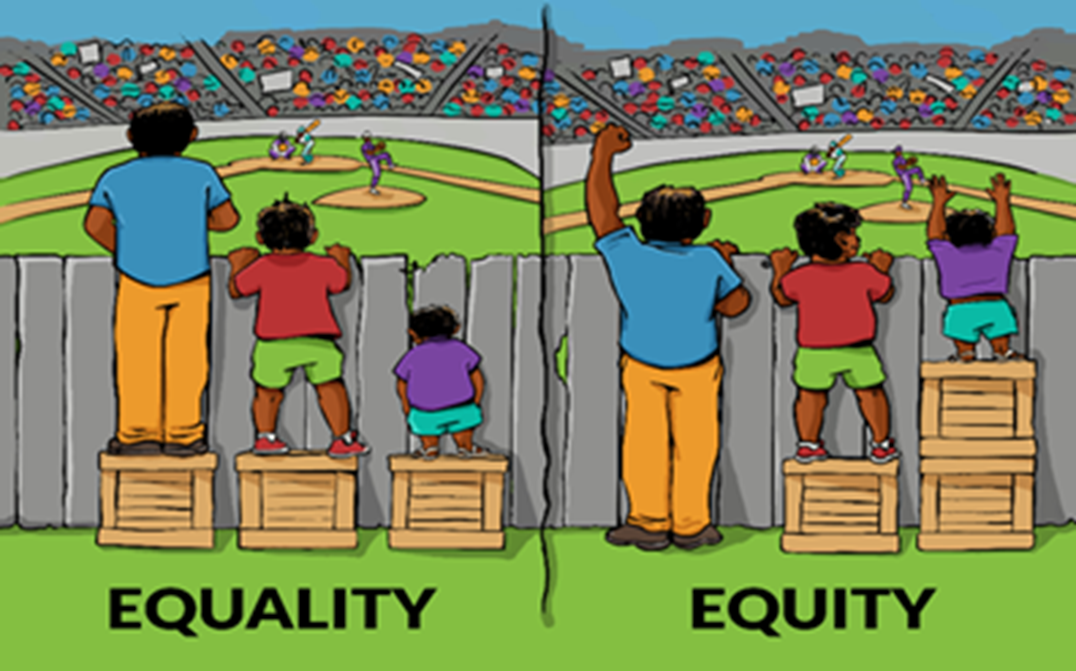
•Example: If you are disabled you need to worry about if a building is accessible. If you are not disabled, you don’t even think about it.
•Example: Everyone gets a pair of glasses (input, fair, equality). We want everyone to see well (output, everyone gets what they need, equity).
“Treating everyone exactly the same is not fair. What equal treatment does is erase our differences and promote privilege. Privilege is when we make decisions that benefit enough people, but not all people.” Amy Sun
So think about outputs first and then work backwards to determine goals and actions to take to meet those goals.

Metrics: Accountability = Trust
I often get asked how leadership can build trust at their companies. I think it is pretty simple, do what you say you’re going to do. When you are accountable to your promises, you build trust. So I suggest you create a very public and consistent way to show (and prove) that you are indeed working towards the goals and outputs you set for your organization.
•Create measurement and indicators so you know you’re making progress. Create a dashboard.
•Establish a baseline with each indicator.
•Measure at multiple points, not just beginning and end.
•Regular surveys.
•Feedback loops.
•Ask the community, employees, etc.
What other ideas do you have to build trust and measure your results?
I had such a great time being interviewed by Michael Hingson from Unstoppable Mindset. We spoke about a variety of topics. Driving the conversation and taking a proactive role is the crux of my conversation. Michael has such an interesting story and perspective, himself. Listen on and contact me with questions, comments and feedback!
…Action is where real change happens. Change can feel thorny but nothing changes without action.
So today is International Women’s Day. First of all, I hate innocuous holidays or celebrations because what purpose do they really serve except for a feel-good?
I say it over and over…
“Talk is cheap. Action is where real change happens!”
It feels good to share platitudes, recognition and high-fives. But my question is, “What are you going to do about it?” Action must happen to make change happen. All the greatest intentions accomplish little. Instead, think about actions you can take to change the system such as:
Share your ideas in the comments. Together we are stronger.
#change #takeaction
Fear holds us back. Fear keeps us from welcoming difference. Fear also forces us out of our comfort zones. I think back on the most pivotal moments in my life and realize that fear held me back but also moved me forward. Some scenarios where fear moved me forward were:
-having a child
-leaving a job
-getting married
-traveling oversees the first time solo
-speaking up when no one else would
-getting divorced
-adopting a child
-saying “yes” to something that I had no idea how to do.
But I believe that if you keep doing things as you always do, things will be guaranteed to stay the same and do we really want a life of sameness??!! Yes there is an inherent risk to pushing your boundaries because you are being pushed into the unknown…and often the outcome turns out to be better than I could have possibly imagined. Hard…yes. Painful…sometimes. But ultimately…better. We have to believe that or we would never move forward and evolve.
I recently recorded my first podcast with an interview with Unstoppable Mindset’s Michael Hingson. Not only was it a good challenge for me, Michael is a force to be reckoned with. Look up his story and sign up for his podcasts. He interviews a very diverse, eclectic cast of professionals and I was lucky to be invited to share my perspective. I will say after the recording (done in one take) I, of course, thought of a million other things I could have said…we really are our own worst critics. Anyway, I thought I would write a few posts on my site about the various topics we discussed…and so the title of this post.
Difference forces us to ask questions. For example, if someone does a task differently from you, it is a great opportunity for you to learn another perspective and then ask questions to continue the learning. We often jump to, “that’s the wrong way to do it” when instead we should relish the fresh perspective and lens.
Traveling is another great opportunity to ask, “Why?” To immerse yourself in a new culture and the joy of the unknown alley is where growth happens. Hang out with a toddler for even 30 minutes and you will get asked “Why” a million times. Why to we stop asking, “Why?” We should keep our eyes that wide and that question in our back pocket for our entire lifetimes.
I love trying new foods, not knowing the language and the general discomfort of not knowing what is around the bend. That doesn’t mean I don’t get sweaty palms and perhaps an increased heart rate, but those reactions certainly prove I am ALIVE and fully immersed in the task at hand.

“A reader lives a thousand lives before he dies . . . The man who never reads lives only one.”
– George R.R. Martin
I am an avid reader and believe in educating myself. In the last year I have read a few books that have been very impactful to me and so I am sharing below. Let me know what books you would add to the list!
But reading is one thing and taking action is another. So once you read the book, what should you do? Here are some ideas
What other ideas do you have? Let me know and I will add them to this post!
I read recently that DEI professionals have an average of an 18 month lifespan (just a little shorter than Greek ruins). I don’t find this surprising given the many stories DEI peers have shared about being in a DEI-focused role in an environment resistant to change…a system resistant to change…a country and even a world resistant to change. Over and over I hear about DEI professionals with targets on their backs for just trying to do their jobs. Why is that? WTF is more like it! I am pretty confident that DEI professionals are not in their jobs to be a “check the box” role in their organizations. DEI work is emotional work. It is hard work and I know we do this work so that we can MAKE a difference, not just serve in a figurehead capacity.
So how do we determine if our role is just fluff filled with lip service? I have a few suggestions of things to dig deeper on to determine if it is time to move to an organization that actually means what they say. To be fair, the type of change we are all working towards is not fast work. The needle will move slowly but it still needs to move and I want evidence that it is actually moving.
Budget. No project, initiative or role can move forward without money. Having a budget (and being able to use that budget) signals that there is validation for your efforts. A budget allows you to tie strategic goals with money to accomplish those goals.
Positions. You might momentarily feel proud of yourself that the organization finally “put their money where their mouth is” and created a full-time, singularly-focused DEI role. You might say to yourself, “finally the organization realizes this role is critical.” But I say not so fast because you will find that there actually is way too much work for one person. One subtle way to stop progress is to bury the DEI professional with so much work that they cannot see the what’s really going on. So, don’t gloat so quickly and instead determine what roles are needed to really do the WORK and then make the case to get those roles hired.
Authority. Do you have a seat at the proverbial table? If not, you will get mired in layers of approvals and suddenly the simplest thing like a educational article or training event will get stuck in roadblocks and potholes. You basically sit at the red light eternally…or until the article or topic’s essence is no longer current with whatever the issue was that you wanted to highlight.
Diversions. Leadership will throw you a bone and tell you how great you are doing…what an awesome influence you are making on the organization. Don’t be fooled…incremental changes like getting the organization to stop using some male-focused words in not what we are after. Yes, it is great to change the bias vernacular that your organization is using but it will never be more impactful than true, systemic changes like digging deep into your recruiting practices and eliminating bias from the process. For example, where does the organization choose to recruit from to how they interview all the way to how they decide if someone is a “fit”. If we continue to hire folks like what we already have then we continue to live in our bubble of sameness.
Employee Resource Groups (ERGs). Creating an environment where ERGs are not only allowed to form, but actually encouraged, will empower employees with shared identities, characteristics, and/or life experiences to come together to collaborate and support each other. It also will enable other employees to learn how to be come allies, a necessary ingredient for change to happen.
We are overdue to band together as a profession and as human beings. As Brene Brown mentioned in her latest book, Atlas of the Heart, “I’m here to get it right, not to be right.” Let’s get it right by setting ourselves up to successfully do the work and make an impact in this world for generations to come. Frankly the world is evolving and change is a part of evolution.
What does getting it right look like? Please comment and let’s figure out how we can support each other and the systemic change so overdue.
I love my “Managing Transitions” book by William Bridges. In the first two chapters he highlights some things he thinks are important to tackle early in a transition process. Bridges presented these recommendations as part of a case study on customer service. Although your specific situation may be somewhat different, I think the principles still apply.
Figure out exactly how individuals’ behavior and attitudes will have to change to make teams work. To deal successfully with transition, you have to determine precisely what changes in their existing behavior and attitudes people will have to make. It isn’t enough to tell them they have to work as a team.
Analyze who stands to lose something under the new system. You can’t grasp the new thing until you’ve let go of the old thing. It’s this process of letting go that people resist, not the change itself. You have to understand the pattern of loss to deal with resistance or even sabotage.
“Sell” the problem that is the reason for the change. Most leaders put 10% of their energy into selling the problem and 90% into selling the solution to the problem. People aren’t in the market for solutions to problems they don’t see, acknowledge, and understand.
Put team members in contact with disgruntled clients, either by phone or in person. Let them see the problem firsthand. (Again, this was relevant to the case study.) This is part of selling the problem. If you are the only one with first-hand experience of the problem, it is going to remain your problem. The key is to make it everyone’s problem.
Talk to individuals. Ask what kinds of problems they are having with “teaming.” When an organization is having trouble with change, managers usually say they know what is wrong. But the truth is that often they don’t. They imagine that everyone sees things as they do, or they make assumptions about others that are untrue.
Talk about transition and what it does to people. Offer leaders training on how to manage people in transition. Everyone can benefit from understanding transition. A coordinator will deal with subordinates better if he or she understands what they are going through. If they understand what transition feels like, team members will feel more confident that they haven’t taken a wrong turn. They’ll also see that some of their problems come from the transition process and not from the details of the change.
Start holding regular team meetings. Even before you can change the space to fit the new teams, you can start building the new identity by having those groups meet regularly. The plan had been to hold meetings every two weeks. Bridges immediately changed that: the teams met for 10 minutes every morning for the first two months. This frequent clustering helped override old habits and self-images and built the new relationships that teamwork requires.
Bridges follows with four more categories of specific tasks:
“The first task of change management is to understand the desired outcome and how to get there. The first task of transition management is to convince people to leave home, to leave what is comfortable and known. You’ll save yourself a lot of grief if you remember that.”
Change is omnipresent in our daily lives. Every year companies initiate thousands of changes. Statistics show that between 50% – 75% of those changes do not produce the expected results. Research points to several reasons for this. The top reasons are:
Often, people resist change based on their perceptions of four factors
identified by William Bridges as C.U.S.P. factors:
Control: How much control do people feel they have over the current situation?
Understanding: Do the people involved understand specifically what is happening and why, in language and terms that are meaningful to them?
Support: Do people feel they have the emotional and practical support necessary to help them get through what they are experiencing?
Purpose: Do people feel they have a purpose in the current change that gives meaning to what they are doing and feeling?
William Bridges, in Managing Transitions: Making the Most of Change, discusses the idea that successful changes are accomplished by managing the transitions that people must go through. He draws a distinction between “change” and “transition” as illustrated below:
Change
|
Transition
|
Transition is the process people go through when adjusting to a change in their lives. There are three phases of transition that must be managed to be able to positively function within the new environment.
Ending
Whenever a change takes place, people lose something. They may lose power, relationships, familiar surroundings, a process they were comfortable with, anything that they had an emotional attachment to. To effectively manage the transition, it is necessary to identify who is “losing” what and acknowledge the loss.
The Neutral Zone
Between the place where the old ways are over but the new ways haven’t quite settled in is the Neutral Zone. People in the Neutral Zone don’t really know what to do. Processes, both new and old, might get dropped. Customer service might go down due to confusion over procedures. To effectively manage the transition, it is necessary to communicate, over and over and over, what part people should be playing, how the change is progressing, and what is over.
However, the Neutral Zone isn’t all “life in limbo.” The Neutral Zone is where the most creative energy lies. During this phase, people are better able to come up with new ways of doing things. Given proper encouragement and authority to innovate, people in the Neutral Zone can really add value to the company.
The New Beginning
When the change finally kicks in and people have accepted the “new order” they have reached the New Beginning. In this phase, the new processes and procedures start to “feel right.”
Change is going to happen whether we like it or not, so why not be a little more thoughtful about the process. I highly recommend reading William Bridges’ work and trying some of the strategies he suggests. Change is inevitable but how we react to the transition is up to each of us.