I always find it very interesting what early adopters latch onto.  And when it comes to technology, I am even more surprised.  Lately, I have read a lot about Pinterest.  I need to play around with it and see what I think but immediately I consider “How can this be used for performance improvement?”  One idea might be to use it to get participants to learn more about each other before an online or face to face session.  Another possibility could be creating a group and have them work in teams to create a pinboard.  The debrief could be an interesting lesson in team dynamics, communication and influence.

What do you think?  Do you think the pinboard could be useful in a training or teaming situation?

Avoid the “Culture Clash”

In the February issue of Chief Learning Officer, there is a great article titled “Your Brain on Culture“.  Neal Goodman points out that “culture provides us with the guide to survival, we naturally feel protected by our own and threatened by other cultures.”  This “Us versus Them” attitude is a natural result of different cultures clashing.  But let’s face it, global intelligence is critical to surviving in today’s workplace.  Certainly a great place to start is knowing time variances and local holidays so that you are not trying to book a meeting or conference call at a disrespectful time.  Recently, I received a request for a conference call at 11 p.m. my time!  Of course I wanted to demonstrate flexibility but the person in Asia should have consulted a world clock so that they knew what they were requesting from me.

Goodman recommends knowing business customs and practices, too.  He relates an example of PUMA trying to sell a shoe with UAE’s flag colors on one of their shoes.  PUMA did not realize that culturally the foot is looked at negatively so putting the flag colors on a shoe must have seemed incredibly disrespectful!  On the flip side, Hilton Hotels created a program to make Chinese guests feel welcome by greeting them in Mandarin (by Mandarin-speaking staff), offering Chinese tv stations and Chinese breakfast items.  How smart and forward thinking!

It is naive to believe that what companies do domestically can easily be replicated globally.  Instead, Goodman suggests some ideas to help your company build cultural intelligence such as:

  • Offer a course on cultural intelligence to your entire workforce
  • Develop global leaders through training and immersion
  • Build global teams
  • Create a database on cultural intelligence.

Finally, Goodman suggests that  “a heightened awareness of cultural differences will allow employees to build bridges of understanding that promote trust, efficiency and effectiveness and increase an organization’s competitive advantage in the global arena.”

Check out the complete article at Chief Learning Officer.  I always read articles with great insight and tips from this publication!

So tell me:

What examples have you seen where companies have been thoughtful about being more culturally aware and responsive? 

What missteps have you seen?

Izzui Webinar

Attended an Izzui webinar. Izzui is a FB application that allows you to create, share, comment, evaluate, track, sell and buy courses. Apart from the selling and buying part, it is all free. Could be a good option for a client with a very limited budget…I need to play with it now that I have a basic working knowledge. Let me know if you try it out.

10 Forces Shaping the Workplace of the Future

Given the time of the year, I thought it might be interesting to share what I am reading regarding the future.  In the October 2011 Talent Management Magazine, David Rasmus wrote an article titled “10 Forces Shaping the Workplace of the Future.”  Read on to see if you are experiencing any of these trends.  First of all, fluid models and the ability to adapt are paramount. 

Rasmus explains that the first concept is Transparency and Trust.  Call me crazy, but I thought trust was a constant (not a new model!)  Out-tasking is the second concept.  In other words, outsourcing is dead.  Managing various resources takes a lot of effort and organization on the company’s part.  They will need to figure out how to manage external resources more effectively.  Needless to say, online reputations are increasingly important.  In the same vane, contractors will be seen as extensions of the organization, rather than independents.

Contract-to-Hire might be the happy medium between renting talent and filling a full-time employee position.  This is an effective way for an organization to “test a new market, experiment with a new technology or evaluate the difference between insourcing and outsourcing.”

Another concept set to evolve is On-boarding.  With increased distributed and global employees, organizations are going to have to reconsider how they onboard new hires.  Other changing concepts are:  Parallel promotions, Hire-to-automate, Business continuity, as well as, Demographic shifts.

 Finally, another huge force is Virtual Work.  As the standard becomes more and more virtual work, location will not be as important.  People will be hired based on knowledge and skills rather than where they are located.  Virtual work also will change how performance management is addressed.  Lots of things to think about as we progress in the working world!
Tech Tools of 2012

November’s  Chief Learning Officer, “Tech Tools in 2012”  caught my eye.   Apparently investment in learning technologies continues to be a priority.  Content development and learning strategy also made the list of priorities.  This means that beyond the LMS, companies want to invest in mobile learning and collaboration tools including social networking tools.  After several years of declining spending, this is good news!

Not surprising, the ability to align all the competing priorities of the organizations is a focus.  CLO’s are focused on the goals of their organization and how to align it with the performance of its employees.  This includes informal learning, leadership training, overall skill development and overall productivity.

Technical tools are still a focus, especially those tools that are more “mainstream” such as learning management systems, elearning content tools and virtual classroom environments.  The jury is still out on how to use social networking, iPads and mobile devices for training.  As these tools demonstrate success and the ability to truly change behavior, I suspect the investment will follow.

Another article that shares the need for training as a continued priority was in Fast Company‘s blog post on training to close the skills gaps that employers whine so often about.  According to the post, many jobs remain unfilled because companies cannot find qualified people.  The old adage “hire for attitude, train for the job” seems to be forgotten.  It is easy to point the finger at our schools, but ultimately companies are going to have to create their own “schools” or universities to address the missing skills that job candidates need.


Creativity Ideas

Sheryl Alstrin and I presented at the Regional ASTD Conference in October.  Our topic was creativity so I thought I would share some of the ideas we presented  over several posts on my blog.

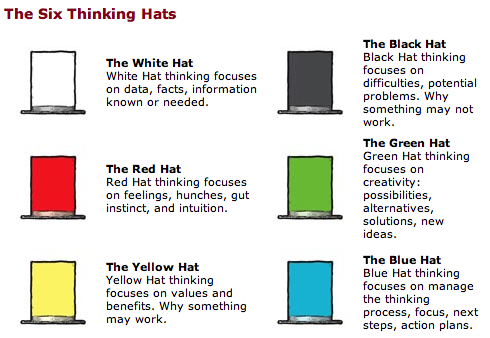
The Six Thinking Hats Overview

  • Six colors of hats for six types of thinking
    • Each hat identifies a type of thinking
    • Hats are directions of thinking
  • Hats help a group use parallel thinking
    • You can “put on” &“take off” a hat

   §   Use the hats for

    • Problem solving
    • Strategic planning
    • Running meetings
    • Much more

To know about the hats:

  • Direction, not description
    • Set out to think in a certain direction
    • “Let’s have some black hat thinking…”
  • Not categories of people
    • Not: “He’s a black hat thinker.”
    • Everyone can and should use all the hats
  • A constructive form of showing off
    • Show off by being a better thinker
    • Not destructive right vs. wrong argument
  • Use in whole or in part

   §   Benefit of the hats:

  • Provides a common language
  • Experience & intelligence of each person (Diversity of thought)
  • Use more of our brains
  • Helps people work against type, preference
  • Removal of ego (reduce confrontation)
  • Save time
  • Focus (one thing at a time)
  • Create, evaluate & implement action plans


Behavior Change

The October issue of CLO Magazine had an interesting article titled “How to Promote Behavioral Change“.  Too often, I have seen the performance appraisal process used as a “one time event”.  Even worse, the contents of the appraisal are often a surprise to the recipient.  How can a manager expect a team member to perform to his best ability, if throughout the year he has no idea if he is meeting the expectations of the job?!  Worse still, what if expectations have not been clearly defined from the outset.  According to the article, top performers are known for three things:

  1. “They know their stuff.
  2. They focus on the right stuff.
  3. They build a reputation for being helpful.”

So if these are the metrics for top performers, as a manager how do you coach and manage your team to do these seemingly simple behaviors?  As the manager, one of your roles is to help your team be successful.  You must give them opportunities to develop the necessary skills and then provide constant feedback along the way.  But there are some additional tactics that the article outlines such as:

  • Tap into the employee’s personal motivation.  Help the employee see the bigger picture and how they fit in it.
  • Continue to help them develop their personal abilities.  This could be in the form of training, but there are other creative ways to do this such as aligning the employee with an expert that they can emulate.
  • Encourage social motivation.  In other words, have your employees hang out with other motivated employees.
  • Match the employee with a mentor.
  • Incent the employees to put their best foot forward with short term rewards to meet their goals.
  • Allow the employee to have some control over their workspace.  For example, if sitting next to the mentor can make a difference, do it!  Even if that means the employee is not sitting in their functional area.

 The article has other great tips, as well as, a case study to review.