Results Without Authority

Just finished writing my review for Tom Kendrick’s book “Results Without Authority”.  If you are a project manager, or just tasked with managing projects, this would be a good book to add to your bookshelf!

Tom Kendrick’s “Results Without Authority” shares strategies, tips and tricks for project managers and the projects they manage.  The greatest challenge for a project manager is to keep a team and project on task, even though the team does not ultimately report to the project manager.  Kendrick believes that three things can keep a project moving forward:  project process, influence and metrics or measurement.  The first half of the book explores these three elements.  The second half of the book examines when to use these elements throughout the project.

Kendrick has a no-nonsense, practical approach to managing projects.  He gives key ideas and the end of each chapter and sprinkles the chapters with lots of example stories.  Although this book is dense, with more information than most 267-paged books, this is a book you will refer to time and time again.

Tiagi’s Four Door Model

I learned something new yesterday and want to share.  I am working on a project that needs to be turned upside down!  I am talking to anyone and everyone about what new ideas are floating around in training.  Someone I met yesterday mentioned Tiagi’s Four Door model.  Anyone who is faintly familiar with training, knows Tiagi.  He is a master at framegrames and that is just the beginning.  He is an energetic, excitable presenter with lots of interesting ideas.  Here is what I found out about his Four Door model:

What is the Four-door Model?
The “four doors” represent four different areas or components of the learning environment:

1. The Library

2. The Playground,

3. The Café

4, The Evaluation Center.

Each of the components
The Library contains the content of the course or module—the information required to master the learning objectives and to successfully complete the final performance test. It typically contains pre-built or existing content, such as videos, documents, slide shows, photos, and audio files. Anything that contains meaningful content and could be put on the Web is used. Learners are invited to study the content in any way they prefer.

The Playground contains fast-paced frame-games that provide practice in recalling and applying the content from the library. They help increase fluency. The frame-games typically require the learner to type or choose short answers. Learners can play each frame game repeatedly at up to three levels of difficulty.

The Café contains social learning activities. A good example is the open-question game which uses open-ended questions to encourage the learner to reflect on the content presented in the library. Learners respond to each question by typing an answer in a text box. When complete, the learner can review the answers given by experts and fellow participants. The café may also include other social-learning components such as wikis, blogs, message boards, etc. Facebook and LinkedIn groups would fall under this category.

The Evaluation Center is simply the test center. It contains the performance test. Ideally, instead of using multiple-choice questions, the evaluation asks the learner to complete or participate in an actual job-related assignment.

The beauty of this model is that the learner can use or not use any of these components.  It allows the learner to decide based on what they need to know and how they like to learn it.  This really ties nicely with the just-in-time learning model that is so prevalent today.  Also, you could name these four components anything you wanted so that it reflects your business and culture.


Happy Cup

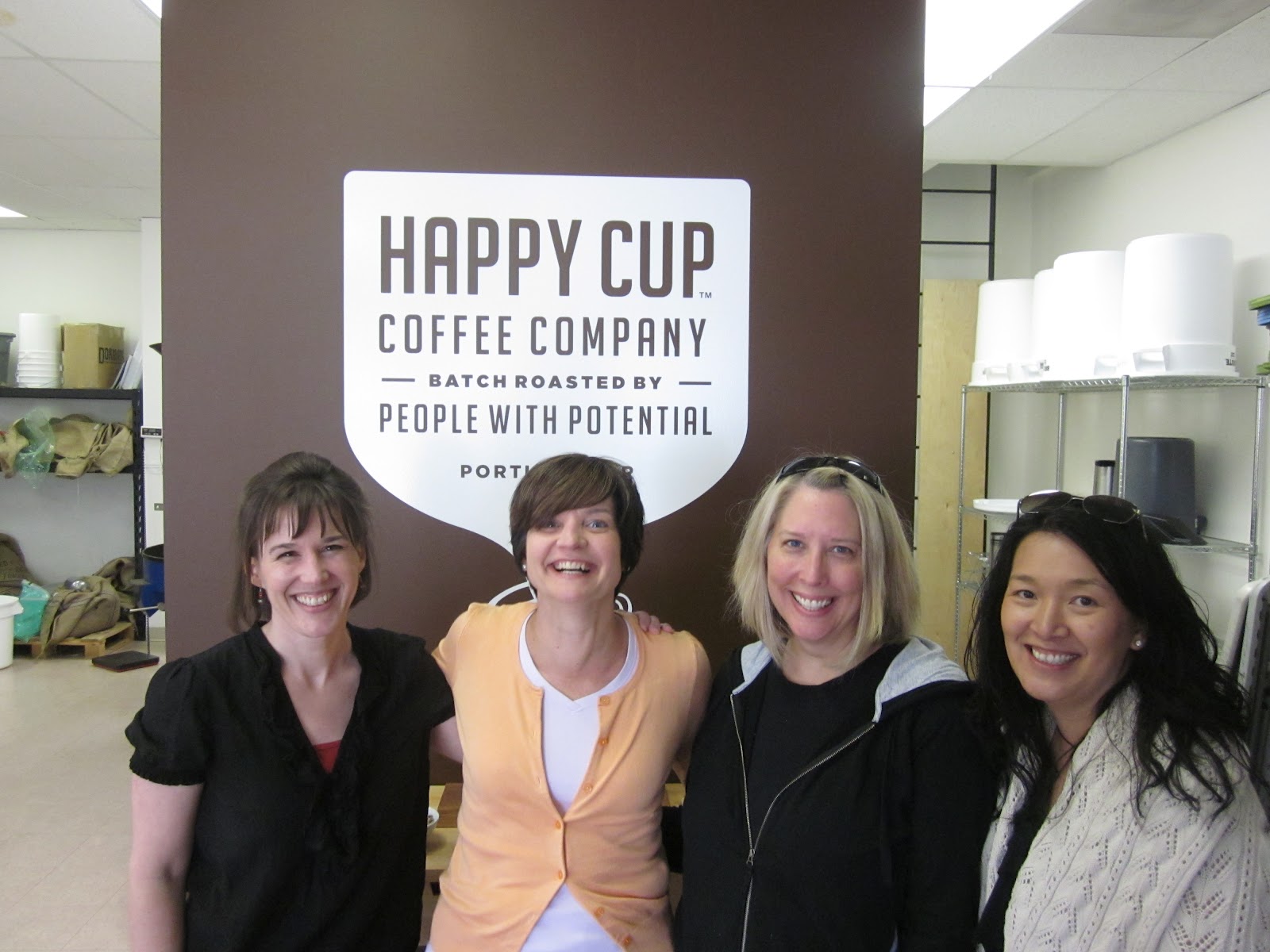
Today was the day…I became Roaster for the Day at Happy Cup Roasting.  About a month ago, I found out I had won Happy Cup’s Roaster of the Day contest.  Apparently there were 300 entries but luck was on my side.  I won coffee for a year, a day with a roaster and a once in a lifetime experience!  I was able to bring three friends with me and so I chose friends that I knew were interested in coffee and that would “blend” well together.

We learned a lot about coffee in general, the roasting process and then blended beans for a one of a kind coffee roast.  The roasting part only took about 13 minutes but apparently can very quickly go awry.  Once we roasted and cooled the beans, we bagged them and then ground some of the coffee to try our creation.  I must say it was very smooth…no milk or sugar needed!!  If you can read the bag, you will see the customized name of my roast:  “Turkish Tornado” and the “Packed by Seniye” and the date on each bag!

The Age of Agility

The May 2012 issue of “Talent Management” has a great article about Unilever’s flexible work model.  Unilever has made a deliberate decision to give its employees the ability to work whenever and wherever they like as long as the work gets done.  I am currently working onsite for a project and when I was hired, I was told I could work remotely as much as I wanted.  I was a bit skeptical but it has turned out to be true.  Although the workplace is extremely flexible, I still need to go in about three days a week.  I need to meet people, test procedures in the lab and ultimately feel connected to the project, the team and the processes. 

Unilever has resolved the disconnect between saying they are flexible with truly being flexible by investing heavily in technology and by eliminating the conventional idea of what an office is and is not.    They build their offices around activities rather than people.  They have three zones:

  1. Focus zones where people come and go and there is no ownership over the work stations.
  2. Connect zones which are spaces for virtual and face-to-face meetings.
  3. Refresh zones are locations stocked with food and gyms.

Unilever has also invested heavily in technology  so that people have great laptops, smart phones and virtual collaboration technology.  Finally, Unilever trained their people on the agile model.  No doubt, some people struggle with the agile model.  I imagine there must be a boss or two that is still “stuck” in the old way of believing face time is best.  For me, disconnecting from work, when my home office is constantly looming is my biggest challenge.  Nonetheless, I applaud Unilever for not just saying they support work/life balance but instead putting together the infrastructure, tools and training to make life/work balance a reality for its employees!


Structured Mentoring

I have created several mentoring programs, both for clients and for teams that I managed when I was an employee.  I really believe that both the mentor and the mentee gain from this relationship.  For the mentor, they gain skills such as how to give feedback and how to provide direction and they are sharing their knowledge, which builds self esteem.  For the mentee, they receive real-time feedback on actual work and hear real-life scenarios and solutions.  Furthermore, if you do it right, you will balance the skills of the mentor and the mentee so that both learn from the relationship.  For example, if as an instructional designer you need both solid writing skills and adult learning theory, put two people together-one with awesome written communication skills and the other with formal adult learning theory knowledge.

One resource that I found valuable when creating a mentoring program was the book, “Making Mentoring Happen” by Kathy Lacey.  Also, in the May 2012 issue of Chief Learning Officer there is an article titled “Breathing the Same Air is Not Enough”.  Although the title is a bit hokey, the main point is dead on.  Oftentimes, companies believe scheduling informal lunches or chats can be considered mentoring.  With that type of setup, it really is only a conversation; the mentee never gets to really dissect real issues.  There needs to be expectations, an action plan, scheduled ongoing meetings, accountability and follow-up.  According to Lollis, “Mentoring needs to be approached with intention and structure.”

Before I launched my mentor program, I provided training for both mentors and mentees.  Both parties need to know expectations, how-to’s and to be given tools to be used to be successful in their respective roles.  I even gave them a list of questions to help get the conversation going, as well as, provide more thought-provoking discussions beyond “How’s it going?”  And don’t discount the possibility of a mentoring program if team members are at a distance.  Mentoring is totally possible with today’s tools such as Skype.

Another article from the May 2012 issue of CLO. 

 What has worked with mentoring programs that you have been exposed to?

Love Learning, Love Change

I love to learn new things.  I love change.  That point of discomfort is when I know I am forcing myself out of “comfort zone”.  I know that most people try to stay as far away as possible from that discomfort zone, but I guarantee that if you are willing to color outside the lines once in a while, you will be amazed at how many new things you can learn. 

Here are some ways that I try to erase the ordinary, both at work and in my personal life:

  • I try at least two new recipes a week.
  • I try to have lunch or coffee with someone I haven’t met at least once a month.
  • I have a list of things I want to learn how to make.  I have mastered cheese, yogurt and bread and my next thing is roasting my own coffee beans.  I will be able to check that item of my list next Saturday, by the way!
  • I read voraciously and read a varied reading list.
  • I volunteer a lot and with a variety of organizations with various missions.
  • I have eclectic interests which means I have an eclectic group of friends and acquaintances which means I am exposed to a wide variety of views, interests and knowledge.
  • I love to travel.  Nothing will get you out of your comfort zone faster than going somewhere that doesn’t speak English!
  • I attend all sorts of webinars on a variety of topics…they cost nothing but my time and I usually garner at least one new nugget of information, thought or idea.

Your Brain on Apps

Your Brain on Apps was another interesting article in CLO’s April 2012 issue: 

http://www.smsepub.com/publication/frame.php?i=103474

Read the article to learn more about how mobile learning should be used to support formal learning and provide performance support.  Since “humans work much better with smaller chunks” (of information) over time,  mobile learning is an obvious solution for job aids, checklists, references and other performance support tools made available just-in-time.

A Critical Eye on Coaching

CLO’s April 2012 magazine had a great article on the benefits of coaching as a leadership development tool. There is a difference between general performance based coaching which happens on a daily basis and executive coaching which is tied to a senior leader’s strategic goals.  Either way, both types of coaching is focused on changing behavior and skill development and requires a committed partnership mindset.

According to Edwards, there is a “six step process for effective executive coaching engagements:

  1. Business need evaluation
  2. Engagement scope, strategy and approach
  3. Coachee assessment
  4. Goal setting/action planning
  5. Coaching engagement delivery
  6. Evaluation and measurement.”

  Read the entire article and additional info:  http://www.smsepub.com/publication/frame.php?i=103474