Second Half Rewrite

For the last six plus years I have explored what could be possible with my reset button. I’ve learned a few things. I have done a ton of research, both formal and informal, explored multiple locations and considered what is most important to me. And, of course, talked to so many people about their experiences, perspectives and ideas.

I realize that change is tough and can even be paralyzing. I can help you:

  • Figure out how to get started.
  • Consider how to keep going.
  • Learn how to pivot.
  • And everything in between.

I have created a subscription Substack. If you want help with your second half contact me and consider signing up for my Substack to get tools, tips and advice.

https://open.substack.com/pub/secondhalfrewrite/p/values

There are no incorrect choices! Please share my website and Substack with others.

Book: “Transitions Making Sense of Life’s Changes” by William Bridges

“Every transition begins with an ending.  We have to let go of the old thing before we can pick up the new one—not just outwardly but inwardly, too.” William Bridges is famous for his transitions framework and this latest book rehashes his three phases of change.  The initial phase of Endings involves acknowledging and processing the losses associated with the old ways of doing things. It’s crucial to allow individuals time to grieve and accept that something is ending before they can move forward. Let’s face it, we are always in a constant state of change given how quickly our world moves.  And whether or not you like change, it is a fact of life so wouldn’t it be effective to have strategies in place to help you with the ending and what is to come afterwards?

During the Endings:

  • Clearly define what is ending.
  • Sort out what parts or aspects you will keep and what you will leave behind.
  • Identify what do you need to unlearn?

In order to end something a few things need to happen.  First, Disengagement, which essentially says you need to feel less attachment to the thing, person or process so ask yourself how you can do that.  Then you need to Dismantle or take apart the structure.  For example, if you have a particular route you take to work but you lose your job, you need to undue your automatic action to take that route in the morning.  One then moves to Disidentification.  Ask yourself, “In what ways are you no longer the person you were?” Then consider Disenchantment to define what no longer holds appeal about that thing or person.  And finally, Disorientation.  What is disorienting to you about this ending? Journaling is a great way to work through these stages.

After the Endings comes the Neutral Zone. This is the “in-between” phase where the old is gone but the new is not fully established. It can be a time of uncertainty, confusion, and even resistance as individuals navigate the unfamiliar.  During this “empty” time take some moments to appreciate this white space to problem solve and creatively process so that new ideas can emerge.  Open yourself to possibilities.  Renewal is the heart of the Neutral Zone.  You begin to see a new way of life, a way of being,  a fertile time for ideas and energy.

This final stage involves embracing the new ways of doing things and building new habits, skills, and relationships called the New Beginnings. Have a plan and purpose.  Focus on achieving small, quick successes.  With each success comes confidence that the change or new thing will eventually feel right.

Read more here.

How can you use this model during your next transition?

Bias and Intersectionality Part Three

Our Inner Bias/Inner Critic can be our own worst enemy. Our inner bias can show up as:

  • Shame
  • Self-doubt
  • Low confidence
  • Beliefs that propel you forward or hold you back

What to do:

  • Be aware of it
  • Pause
  • Show yourself compassion
  • Get curious

Calm you inner bias:

  • Explore what beliefs hold you back.
  • Decide what different data can you use to make different assumptions.
  • What contrary evidence exists?  Choose to scrutinize your assumptions.

Bias and Intersectionality Part Two

Women are in a “no win” situation and walk a tightrope of meeting societal demands for women to demonstrate female characteristics of compassion, warmth, communication and collaboration vs leadership characteristics  (dominated by male characteristics) of forceful, assertive, dominant and competitive.

Did you know? When women display male characteristics, they are seen as competent but not liked.  When they display female characteristics they are viewed as less competent. Women leaders are seen as competent or likeable but rarely both. I saw this play out in my own career and it is incredibly frustrating.

And when you add women of different race, ethnic, sexual and gender identities to the tightrope of gender bias it gets even more complicated navigating the ladder to success.

A few ways bias shows up:

  • Pay gap
  • #Metoo  wakeup call  sexual abuse, harassment, microaggressions at work
  • COVID and “second shift” awareness
  • Who gets promoted or the cool assignments
  • Who gets listened to

How else have you seen bias show up?

Bias and Intersectionality

I am presenting the topic of Bias and Intersectionality this week. It is to a group of women new in their careers. Bias is a well-used word but what does it really mean?

Fact: The world does not view women and men the same.

Gender bias is: When people show favoritism toward one gender over another.

Women vs Men:

  • Conscious and unconscious. = women and men are treated differently.
  • Bias is hardwired in our brains to help us make sense of the world quickly.
  • Bias creates different expectations for different genders (in this example).
  • Bias transforms into prejudice, differential treatment and inequality.
  • Women and men experience the world in vastly different ways. 
  • Social norms continue to reinforce this bias.

What examples have you seen where bias comes into play?

Jumpstart Your DEIB Efforts

I recently spoke at an HR & Benefits conference on how to begin and/or refine your DEIB efforts in order to actually be successful in moving the needle in this important work. I will share some of my ideas over several posts. Contact me if you want to know more!

First let’s lay the foundation of some definitions. I adapted this Bank of America graphic and added the Belonging information. So if you start with these definitions and develop outcome goals from there, you will focus on the right outcomes and the right problems so that you design the right solutions. When developing your strategy, know your starting point and what you want the future state to look like and achieve.

A few other things to think about as you develop a strategy:

•Know the power dynamics at your organization.

•Know what you will measure and how.  How do we know we have met our outcome goals?

•Establish a baseline-employee satisfaction, engagement, retention, turnover, demographics, surveys.

•Identify resources: Internal/ external.

•Budget: You need one!

•Define terms so that everyone understands.

•Create a playbook.

•Don’t try to take on too much.

I’ll stop there. My next post will continue the conversation on developing a DEIB focus at your organization. Leave a comment if you have any other ideas when developing a strategy.

My First Podcast Interview

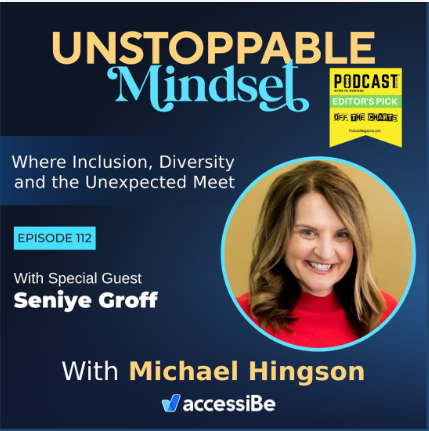
I had such a great time being interviewed by Michael Hingson from Unstoppable Mindset. We spoke about a variety of topics. Driving the conversation and taking a proactive role is the crux of my conversation. Michael has such an interesting story and perspective, himself. Listen on and contact me with questions, comments and feedback!

Fear and My Most Pivotal Moments

Fear holds us back. Fear keeps us from welcoming difference. Fear also forces us out of our comfort zones. I think back on the most pivotal moments in my life and realize that fear held me back but also moved me forward. Some scenarios where fear moved me forward were:

-having a child

-leaving a job

-getting married

-traveling oversees the first time solo

-speaking up when no one else would

-getting divorced

-adopting a child

-saying “yes” to something that I had no idea how to do.

But I believe that if you keep doing things as you always do, things will be guaranteed to stay the same and do we really want a life of sameness??!! Yes there is an inherent risk to pushing your boundaries because you are being pushed into the unknown…and often the outcome turns out to be better than I could have possibly imagined. Hard…yes. Painful…sometimes. But ultimately…better. We have to believe that or we would never move forward and evolve.

Why Difference is Such a Great Teacher

I recently recorded my first podcast with an interview with Unstoppable Mindset’s Michael Hingson. Not only was it a good challenge for me, Michael is a force to be reckoned with. Look up his story and sign up for his podcasts. He interviews a very diverse, eclectic cast of professionals and I was lucky to be invited to share my perspective. I will say after the recording (done in one take) I, of course, thought of a million other things I could have said…we really are our own worst critics. Anyway, I thought I would write a few posts on my site about the various topics we discussed…and so the title of this post.

Difference forces us to ask questions. For example, if someone does a task differently from you, it is a great opportunity for you to learn another perspective and then ask questions to continue the learning. We often jump to, “that’s the wrong way to do it” when instead we should relish the fresh perspective and lens.

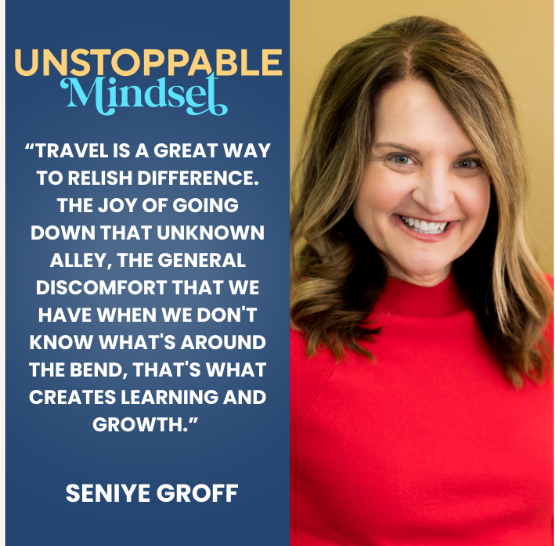
Traveling is another great opportunity to ask, “Why?” To immerse yourself in a new culture and the joy of the unknown alley is where growth happens. Hang out with a toddler for even 30 minutes and you will get asked “Why” a million times. Why to we stop asking, “Why?” We should keep our eyes that wide and that question in our back pocket for our entire lifetimes.

I love trying new foods, not knowing the language and the general discomfort of not knowing what is around the bend. That doesn’t mean I don’t get sweaty palms and perhaps an increased heart rate, but those reactions certainly prove I am ALIVE and fully immersed in the task at hand.

The Post-Pandemic World

I was recently asked, “What’s different now that the pandemic is behind us (hopefully)?” As people professionals, we are often on to the next crisis and don’t have time to stop and reflect on the tsunami of the last two years. So, I really appreciated the question and the invitation to pause and consider this important question.

First and foremost, I think employees got comfortable with advocating for what they need. They are no longer afraid to say, “Timeout, that doesn’t work for me any longer.” I also believe that the conversations around mental health are super healthy. In essence, mental health is now considered a health issue similar to a routine physical or having a baby. It is long overdue that the stigma of mental health disappears. This translated to believing it is okay for employees to use their benefits. Previously employees were afraid to use their PTO as it might indicate a lack of dedication to their job, but now taking PTO is a health imperative. Relaxing and rejuvenation is indeed exactly what the doctor ordered!

More than ever the employee experience is key. This starts with leadership. Employees are not in the child role, while leaders are in the parent role. Work is a partnership so leaders you are now on notice that employees expect collaboration, respect and transparency. The employee experience starts with the job posting and carries all the way to retirement or termination. Words on a wall are not enough…ask the difficult questions about what candidates and employees want and what drives employees away from your organization when they decide to leave.

Values, inclusivity and belonging are here to stay. These are not catch phrases or a check the box effort. Employees want to make sure the organization they join or work for are aligned to their “why”. If there is no alignment, it will just be a “job” and you will not get the employee’s passion, which is where true performance happens. And for those companies that think the focus on diversity, equity and inclusion (DEI) are a passing flavor of the month, I am happy to inform you that is not the case. It is here to stay and employees expect identifiable action and results.

So I challenge each leader, regardless of the role or title, to lead with empathy and advocacy. Build skill development plans not only for leaders, for all employees. After all, work has changed and the skills needed to be successful on the job (and life) need to evolve, too. And finally, ensure your company’s values are aligned with the daily actions that employees are accountable and rewarded for to ensure a robust employee experience.

What others things have you seen that are different post-pandemic?