Bias and Intersectionality Part Three

Our Inner Bias/Inner Critic can be our own worst enemy. Our inner bias can show up as:

  • Shame
  • Self-doubt
  • Low confidence
  • Beliefs that propel you forward or hold you back

What to do:

  • Be aware of it
  • Pause
  • Show yourself compassion
  • Get curious

Calm you inner bias:

  • Explore what beliefs hold you back.
  • Decide what different data can you use to make different assumptions.
  • What contrary evidence exists?  Choose to scrutinize your assumptions.

Bias and Intersectionality Part Two

Women are in a “no win” situation and walk a tightrope of meeting societal demands for women to demonstrate female characteristics of compassion, warmth, communication and collaboration vs leadership characteristics  (dominated by male characteristics) of forceful, assertive, dominant and competitive.

Did you know? When women display male characteristics, they are seen as competent but not liked.  When they display female characteristics they are viewed as less competent. Women leaders are seen as competent or likeable but rarely both. I saw this play out in my own career and it is incredibly frustrating.

And when you add women of different race, ethnic, sexual and gender identities to the tightrope of gender bias it gets even more complicated navigating the ladder to success.

A few ways bias shows up:

  • Pay gap
  • #Metoo  wakeup call  sexual abuse, harassment, microaggressions at work
  • COVID and “second shift” awareness
  • Who gets promoted or the cool assignments
  • Who gets listened to

How else have you seen bias show up?

Bias and Intersectionality

I am presenting the topic of Bias and Intersectionality this week. It is to a group of women new in their careers. Bias is a well-used word but what does it really mean?

Fact: The world does not view women and men the same.

Gender bias is: When people show favoritism toward one gender over another.

Women vs Men:

  • Conscious and unconscious. = women and men are treated differently.
  • Bias is hardwired in our brains to help us make sense of the world quickly.
  • Bias creates different expectations for different genders (in this example).
  • Bias transforms into prejudice, differential treatment and inequality.
  • Women and men experience the world in vastly different ways. 
  • Social norms continue to reinforce this bias.

What examples have you seen where bias comes into play?

“The Wake Up’ by Michelle Mijung Kim

I believe it is important to constantly continue to learn. And I love learning new things to to help me consider other points of view. So, I was definitely intrigued to read Kim’s book. She is a queer, immigrant Korean American woman writer and like every other person in this world, she has a unique perspective. This perspective informs her work in the DEI space. The premise of this book is good intentions vs. real change, which also is challenge in the DEI space.

Some things that I liked from this book:

  • Her definition of allyship. She states that it is, “the active and consistent practice of using power and privilege to achieve equity, inclusion and justice while holding ourselves accountable to marginalized people’s needs.
  • I agree with her comment that good intentions produce unwanted outcomes all the time. “Doing good” is not the end game. Validation must come from the group that is marginalized. They decide what doing good really means. For example, ” By failing to set accountability metrics that are driven by the very people such initiatives have been created to support, companies end up solving nothing and doing no good.”
  • Kim’s distinction of do-gooders vs each of us owning that we “each play a critical role in upholding and dismantling systemic oppressions that ultimately impact all of us.” Who does your “why” serve? Yourself? Or historically marginalized people?
  • We need to understand they ways in which we are harmed by or benefitting from different systems of oppression. We all benefit from some and cause harm in other ways. And the belief that everyone has the opportunity to succeed through hard work and their own skills is a myth. The folks that hold the power, access and resources while not acknowledging the barriers marginalized people face, have enjoyed success, believing they earned (and deserve) their success.
  • I think about the Afghan man that I am teaching English to and how motivated he is to learn so that he can improve his opportunities. Someone that already speaks English clearly has advantages over this immigrant. This is a simple example but shows how inequities begin and stay in place.
  • White supremacy exists in every system we have in place: work, healthcare, criminal justice system, real estate, the interviewing and hiring process…the list goes on and on. “Racism is a complex set of systems, policies and beliefs that reinforce the marginalization of people while privileging white people in society.”

Kim lists a few questions to help guide us:

  • Who has the power?
  • How is the power being used?
  • Who benefits?
  • Who is harmed?
  • What historical, social, cultural or political context might I be missing?

There is so much to this book, I am going to write multiple posts about it!

“Say the Right Thing”

I love learning new things and certainly have spent the last several years reading, watching and listening to anything I can get my hands on about diversity, equity, inclusion, bias and belonging. So I recently picked up, “Say the Right Thing” by Kenji Yoshino and David Glasgow. The premise of the book is to learn how to talk about identity, diversity and justice.

The authors suggest a framework called A.D.D.A. which stands for avoid, deflect, deny and attack. The authors contend these are conversational traps that one needs to be aware of and prepare for as one tries to have conversations around identity, diversity and justice issues. I thought this framework really did capture how conversations derail, sometimes before they even start!

One line in the book really captured the issue for me:

As excruciating as it can feel to have conversation about identity, it’s important to remember people from nondominant groups have always experienced emotional turmoil in these dialogues from being ignored, mocked, tone policed, or subjected to retaliation. When you find yourself wondering, “Why am I so uncomfortable? You might instead ask, “Why have I been comfortable until now?” You might then hear the answer: “I’ve been comfortable because until today, the other person has carried all the discomfort on their own.”

The authors suggest some strategies to deal with the emotional discomfort of these types of conversations such as a growth mindset by treating mistakes as opportunities to learn, self-affirm by reminding yourself what is most important and right-size feedback by remembering claims about privilege are often not as extreme as you perceive them. Reframing the situation can make you more open to the conversation in an objective way.

There are lots of helpful nuggets in this book. The authors share stories, examples and suggestions. One of the ending notes I think was helpful, “Don’t ignore people’s group identity, but also don’t reduce them to their group identity.” And finally, educate yourself! It is your responsibility to do so. Be curious, humble and ask for help but don’t expect someone else to educate you. Check out this book and let me know what you learned.

Equity vs Equality: Input vs Output

•Example: If you are disabled you need to worry about if a building is accessible.  If you are not disabled, you don’t even think about it.

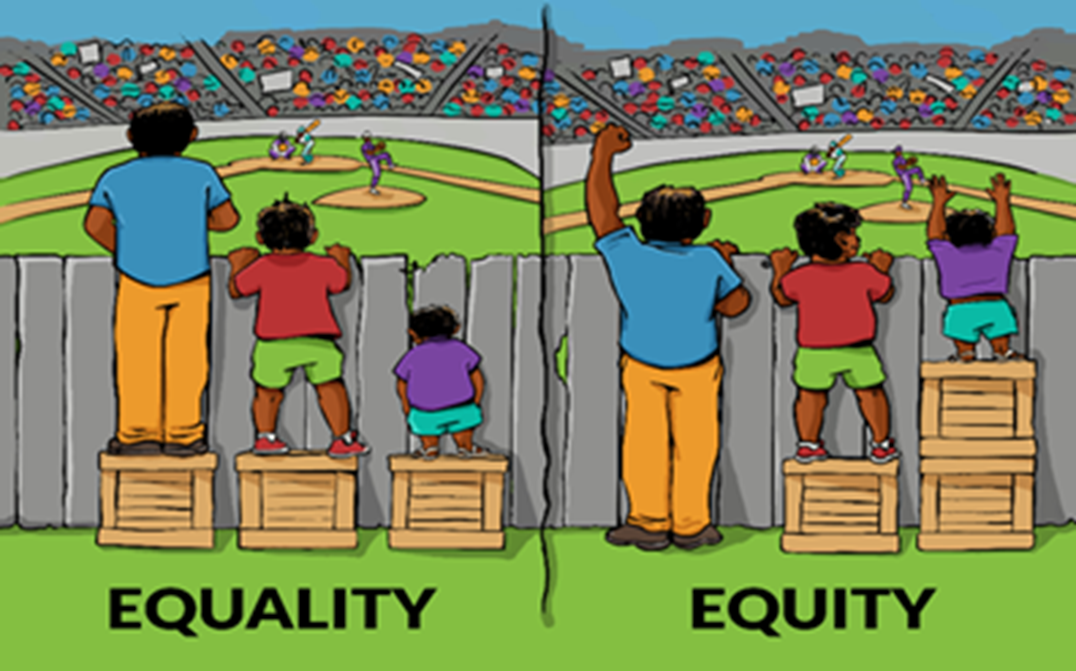
•Example:  Everyone gets a pair of glasses (input, fair, equality). We want everyone to see well (output, everyone gets what they need, equity).

“Treating everyone exactly the same is not fair.  What equal treatment does is erase our differences and promote privilege.  Privilege is when we make decisions that benefit enough people, but not all people.”  Amy Sun

So think about outputs first and then work backwards to determine goals and actions to take to meet those goals.

Metrics:  Accountability = Trust

I often get asked how leadership can build trust at their companies. I think it is pretty simple, do what you say you’re going to do. When you are accountable to your promises, you build trust. So I suggest you create a very public and consistent way to show (and prove) that you are indeed working towards the goals and outputs you set for your organization.

•Create measurement and indicators so you know you’re making progress.  Create a dashboard.

•Establish a baseline with each indicator.

•Measure at multiple points, not just beginning and end.

•Regular surveys.

•Feedback loops.

•Ask the community, employees, etc.

What other ideas do you have to build trust and measure your results?

Jumpstart Your DEIB Efforts

I recently spoke at an HR & Benefits conference on how to begin and/or refine your DEIB efforts in order to actually be successful in moving the needle in this important work. I will share some of my ideas over several posts. Contact me if you want to know more!

First let’s lay the foundation of some definitions. I adapted this Bank of America graphic and added the Belonging information. So if you start with these definitions and develop outcome goals from there, you will focus on the right outcomes and the right problems so that you design the right solutions. When developing your strategy, know your starting point and what you want the future state to look like and achieve.

A few other things to think about as you develop a strategy:

•Know the power dynamics at your organization.

•Know what you will measure and how.  How do we know we have met our outcome goals?

•Establish a baseline-employee satisfaction, engagement, retention, turnover, demographics, surveys.

•Identify resources: Internal/ external.

•Budget: You need one!

•Define terms so that everyone understands.

•Create a playbook.

•Don’t try to take on too much.

I’ll stop there. My next post will continue the conversation on developing a DEIB focus at your organization. Leave a comment if you have any other ideas when developing a strategy.

Conversations About Race

I recently finished reading “How to Have Difficult Conversations About Race” by Kwame Christian. I believe stumbling blocks do exist about how to get the conversation started and folks avoid the tough discussions all together. Conversations about race are loaded with minefields of discomfort, misunderstanding and lack of know-how. But does that mean we avoid these discussions all together?! Absolutely not because if we avoid, we never solve.

I loved Kwame’s suggestion to mobilize compassionate curiosity. For one thing, what a great way to remove defensiveness by calling it curiosity. His framework includes three steps:

  1. Acknowledge and validate emotions.
  2. Get curious with compassion.
  3. Use joint problem solving.

Compassionate curiosity can (and should) not only be used with others, but also yourself. I have spoken before about being on auto-pilot and a great way to move away from this mindless way of acting is to stop and question yourself (and others) on why they believe something…in other words step back to self-reflect. Other phrases such as, “Tell me more about…and help me understand” are powerful, empathetic ways to learn where someone is coming from. Kwame’s book walks through this methodology in great detail and with examples, which are very helpful to guide the reader into action (and comfort).

Another eye opener in his book discusses speaking the same language. Kwame states, “The dictionary definition of a word isn’t important. What’s important is what the person you’re talking to believes the word to mean.” Great examples are the words privilege and inclusion. I loved his explanation of how conversations get derailed when agreement on what the word even means is not established yet! I am definitely adding this important step to my conversations. Check out chapter six to learn more and get detailed examples.

It is not new information to not speak in absolutes and Kwame touches on this, too. He suggests to use often instead of the word always. Also, use likely or frequently instead of will and finally use rarely or infrequently instead of never. Just say those words aloud and you can already sense how the conversation can change for the better.

In my mind taking action is front and center and Kwame focuses the last section of his book on this important verb. He states, “racial inequity is a problem of bad policy not bad people.” So he is a proponent of changing inequitable policies that create inequitable outcomes rather than individual beliefs. “Progress doesn’t move at the speed of comfort.” Wow and YES! If we wait for people to be comfortable we will never move…we will wait forever. And my biggest pet peeve, hope vs. action. For example, our hope and prayers are with families every time there is a mass shooting but until we actually take ACTION and change policy, nothing will truly change. Kwame suggests that with policy change hearts and minds actually do change. An example is how organizations had to quickly pivot due to COVID-19, whereas in typical times that severe change would have taken likely decades!

Another powerful sentiment of Kwame’s that I definitely know about (and likely anyone in the DEI space has experienced) is this:

“When you’re advocating for change within your organization, you may be seen as an irritant, too. Difficult conversations can make people uncomfortable and that discomfort can lead people to blame the irritant, because it seemed as though everything was fine before someone spoke up. People often struggle to see a problem if it’s not a problem for them. But the irritant of advocacy is the medication necessary to cure the greater ill of racism.”

“The End of Bias: A Beginning” by Jessica Nordell

“Bias is normal but not acceptable”

Jessica Nordell

Nordell’s book shared some concepts that I think are worth repeating. I certainly have been penalized for speaking out during my career, but imagine how much more difficult it is for marginalized folks. I loved her thought about seeing differences does not matter but instead, it’s how we react to differences in harmful ways that count. What comes to mind for you? How have you reacted negatively when someone has shared something different from what you believe or think?

Another idea that resonated for me in the book was the idea to “notice when stereotypes arise and actively replace with alternative images.” Wow! In other words, look for situational reasons for a person’s behavior rather than assuming it comes from inherent characteristics. This recently came to life in a conversation with a peer when they were relating a story of a recent interview they held with two candidates. The candidates qualifications were similar (one had more formal education, the other had more hands- on experience) and they ended up choosing the candidate with more education. I asked, “Why?” and then I followed up with, “Perhaps the second candidate did not have access to additional education”. My peer responded with “Funny you say that. When I called the candidate and let him know he was not chosen, he said that exact thing”. It is important to remember that marginalized folks often go to underfunded schools with less resources. It is not intentional on their part to get a subpar education…the system creates this inequity in education.

I love how Nordell distills bias to a choice. A choice that you can change by eliminating automatic thinking and instead use conscious deliberation. So, do I accept my automatic evaluation of people or do I try something new? Do I believe my first reaction or do I stop to look for further evidence?

Stop and scrutinize initial assumptions and envision an alternative explanation. Shift from simply reacting to observing your reaction. Frankly this action could work in many parts of life, not just bias. But, it certainly would be a big WIN if we could do it with our own bias.

Let me know your thoughts!