“Say the Right Thing”

I love learning new things and certainly have spent the last several years reading, watching and listening to anything I can get my hands on about diversity, equity, inclusion, bias and belonging. So I recently picked up, “Say the Right Thing” by Kenji Yoshino and David Glasgow. The premise of the book is to learn how to talk about identity, diversity and justice.

The authors suggest a framework called A.D.D.A. which stands for avoid, deflect, deny and attack. The authors contend these are conversational traps that one needs to be aware of and prepare for as one tries to have conversations around identity, diversity and justice issues. I thought this framework really did capture how conversations derail, sometimes before they even start!

One line in the book really captured the issue for me:

As excruciating as it can feel to have conversation about identity, it’s important to remember people from nondominant groups have always experienced emotional turmoil in these dialogues from being ignored, mocked, tone policed, or subjected to retaliation. When you find yourself wondering, “Why am I so uncomfortable? You might instead ask, “Why have I been comfortable until now?” You might then hear the answer: “I’ve been comfortable because until today, the other person has carried all the discomfort on their own.”

The authors suggest some strategies to deal with the emotional discomfort of these types of conversations such as a growth mindset by treating mistakes as opportunities to learn, self-affirm by reminding yourself what is most important and right-size feedback by remembering claims about privilege are often not as extreme as you perceive them. Reframing the situation can make you more open to the conversation in an objective way.

There are lots of helpful nuggets in this book. The authors share stories, examples and suggestions. One of the ending notes I think was helpful, “Don’t ignore people’s group identity, but also don’t reduce them to their group identity.” And finally, educate yourself! It is your responsibility to do so. Be curious, humble and ask for help but don’t expect someone else to educate you. Check out this book and let me know what you learned.
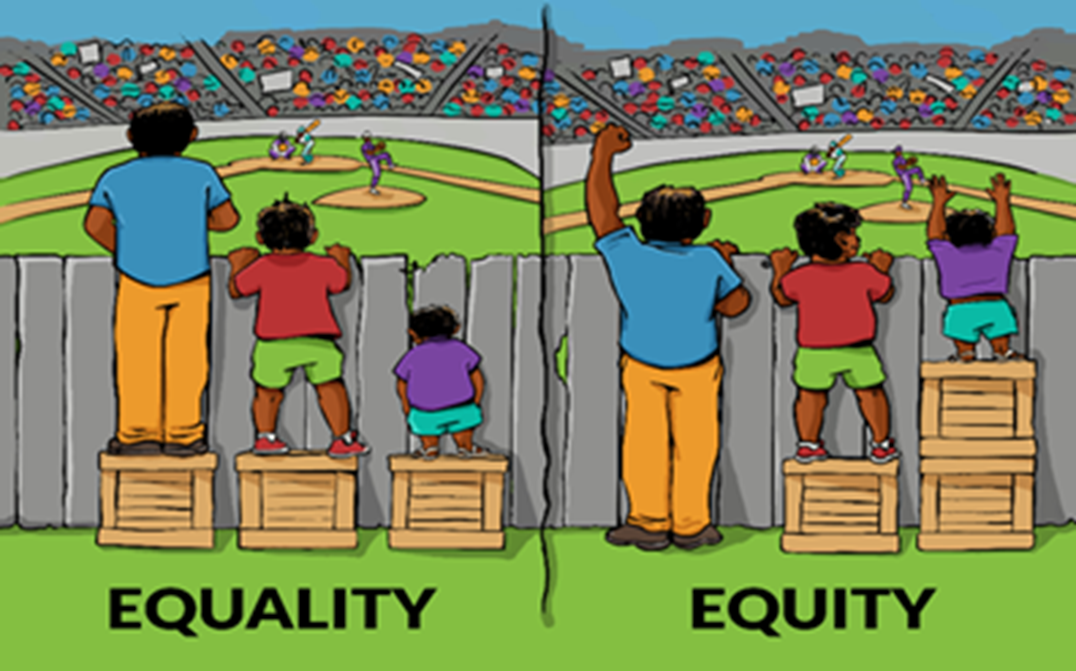

Equity vs Equality: Input vs Output

•Example: If you are disabled you need to worry about if a building is accessible.  If you are not disabled, you don’t even think about it.

•Example:  Everyone gets a pair of glasses (input, fair, equality). We want everyone to see well (output, everyone gets what they need, equity).

“Treating everyone exactly the same is not fair.  What equal treatment does is erase our differences and promote privilege.  Privilege is when we make decisions that benefit enough people, but not all people.”  Amy Sun

So think about outputs first and then work backwards to determine goals and actions to take to meet those goals.

Metrics:  Accountability = Trust

I often get asked how leadership can build trust at their companies. I think it is pretty simple, do what you say you’re going to do. When you are accountable to your promises, you build trust. So I suggest you create a very public and consistent way to show (and prove) that you are indeed working towards the goals and outputs you set for your organization.

•Create measurement and indicators so you know you’re making progress.  Create a dashboard.

•Establish a baseline with each indicator.

•Measure at multiple points, not just beginning and end.

•Regular surveys.

•Feedback loops.

•Ask the community, employees, etc.

What other ideas do you have to build trust and measure your results?

Build Your DEI Program

Last week I spoke at the #HRTED2022 conference about ideas to build your internal DEI program. Primarily this session focused on four elements of a program, internships and employee resource groups (ERGs). I want to share the main points of the presentation. If you want more information, please contact me. This post will touch on the four elements and internships. My next post will focus on ERGs.

The four elements of a DEI program consist of:

  • Metrics-identify what and how you are going to measure your program.
  • Process-consider the many processes in your organization including people, operations and purchasing.
  • Education-there are lots of training needs so make sure you force rank them, determine your strategy and how you will measure effectiveness.
  • Initiatives-this is where internships, ERGs, mentorships, leader cohorts and many other programs come into play.

Make sure you create organizational buy-in.

  • Develop a business case for why DEI matters to organizational goals and success
  • Conduct an honest assessment of whether the organization can support diverse interns
  • Be prepared to answer difficult questions
  • Demonstrate patience

Engagement Strategy:

  • Foster an inclusive environment
  • Create micro-connections
  • Engage executive team
  • Establish intern cohorts
  • Pair interns with a strong mentor
  • Maintain frequent check-ins

Put Learning in the Employees Hands

Something phenomenal has happened recently in my workplace—an entire behavior shift that I at first believed would never take hold in our fast-paced, ever-changing environment. I decided to put learning in the employee’s hands in the form of an Individual Learning Plan (ILP).

Our company culture advocates the “51 percent” rule, which dictates that employees determine what to work on and go after it with a zeal not commonly found in a typical organization. In other words, no rules, no asking permission, but instead just do it. And so I figured: Why not take that approach in employee development, too?

Every road trip starts with a good map. Whether electronic or an old-fashioned paper map, good up-front planning allows for a more successful outcome (including seeing all the famed attractions) and potentially the trip of a lifetime. So, imagine a world where your employees know exactly what they are good at, what they need to work on, and what tools to explore on their path to self-development. It is possible—with some up-front planning and targeted conversations throughout the year, coupled with a detailed document, the Individual Learning Plan. I am a strong proponent of the almighty (and highly underutilized) ILP. Learning plans are the customized, individualized road map for your employees to ensure they are aware of both the skills they need to develop and a defined path to achieve those skills.

Your ILP should contain a minimum of three things:

  • Learning objectives
  • Strategies and resources
  • Evaluation

Essentially, ask the employee to document answers to these three questions:

  • What do I need to learn?
  • How am I going to learn it?
  • How will I know that I learned it?

Allow the employee to search for resources internally and externally. Suggest a mix of self-paced seminars, courses, and learning situations to develop the identified weak skill.

For example, let’s say you have an employee who needs to develop their communication skills. You might have an internal training session on that specific topic. Or perhaps this employee would be better served by learning and practicing communication skills with an outside resource—or maybe signing up for a group that meets weekly is a better fit. Perhaps there is another employee who has honed their communication skills to perfection and could provide guidance to this employee. Whatever the resource, let the employee figure out the best fit. But guide the employee with resources they might not be aware of. There is no one path to reach the desired destination; allow the available resources and best fit to define the route. During this process, the employee receives targeted feedback on how they are doing that gets documented in the learning plan, too.

No one likes to search aimlessly for the correct exit or next tourist destination, so provide a road map so that your employees can reach skill nirvana while dealing with the day-to-day challenges of completing their job tasks. The employees benefit from better self-esteem and higher productivity, the company benefits from employees who feel nurtured and supported, and ultimately, everyone reaches the intended destination in a more effective, positive manner.

Surprisingly enough, at a recent all-company meeting, ILPs were mentioned in several sessions. It appears the entire vernacular of the company now includes the Individual Learning Plan as a path to employee development—and ultimately engagement—that the employee controls, drives, and benefits from in their career path.

The Power of Surveys…with the Right Preparation

It seems like I am constantly being asked to complete a survey.  And as a trainer, I ask all my participants to provide feedback via a survey.  But I have noticed that often I do not get the complete, insightful answers I hoped to get.  So, we need to teach people how to answer a survey effectively.  This does not mean “lead the witness” or direct responders to give you the answer you are looking for.  Instead, help the responder by giving him the tools to answer the question, so that meaningful information can be gleaned from the response.

  1. Ask the responder to take their time. We are all inundated with too many emails, phone calls, job deliverables and personal responsibilities.  It is a wonder we sleep at all!  But ask the responder to find the right time to be able to give the survey the time it deserves.  This allows the responder to give thoughtful answers.  I even recommend that the responder make some mental or written notes prior to starting the survey so that they know what information is important to convey once they are in the survey.
  2. If the responder does not have the answer right away, come back to it. Sounds like the old days of taking tests doesn’t it?!  Better answers happen when we have time to think it through.
  3. Be honest but constructive. It goes back to the old adage of the glass being half full or half empty.  If you see the question as an opportunity to solve a problem or improve something, it is likely that your answer with be more constructive and solution-oriented.
  4. Keep it professional. Use words that convey the correct meaning and give examples.  The answer will be of no value if it reads like a personal vendetta or feels like a personal attack on someone.
  5. Provide suggestions. Paint a picture for the feedback-seeker to understand what you are trying to say and the intention of the feedback.  If you have had time to think about your answer or the issue being asked about, the more likely ideas about the issue are developed.

Teaching your employees to answer thoughtfully and thoroughly when questions are asked, gives the organization the information they need. Getting the needed information ensures that the organization can make the intended change or improvements.   Also, showing your employees how the survey responses can benefit them with improved processes or communication can gain buy-in from the employees.  So set your employees up for success by teaching them how to be effective survey responders.

The Power of Stories and Training

Stories can be used quite effectively for training. Often, training consists of a PowerPoint deck, a presenter that talks a lot or tons of handouts.  Engaging it is not.  But stories can bring content to life and stories are everywhere; you just need to look!

  • Stories make the content relatable and easier to remember.
  • Stories help the learner construct knew knowledge by taking current knowledge and applying in a new or different manner.
  • Stories provide examples which helps when a learner needs to make a decision.
  • Stories give the learner the ability to recall and use information when they are on the job and in their own context.

So how do you effectively use stories in training?  Start with throwing the learner into the action.  Or focus on something the learners care about right away.  Build opportunities for the learner to discover and give the learner the challenge of solving a problem.

Some tips:

  • Start with discovery
  • Focus on a central challenge
  • Give learners resources to uncover answers
  • Make the transformation obvious.

Think about the last training you went to.  Can you remember the discrete facts and figures shared?  Probably not.  But if you were lucky and the facilitator shared stories, I bet you can remember the story and possibly even have shared the story with someone else!  Stories are powerful in so many ways,  so the next time you are developing training, choose to center your content around stories and watch the magic happen.


Managing Transitions and William Bridges

I love my “Managing Transitions” book by William Bridges. In the first two chapters he highlights some things he thinks are important to tackle early in a transition process. Bridges presented these recommendations as part of a case study on customer service. Although your specific situation may be somewhat different, I think the principles still apply.

Figure out exactly how individuals’ behavior and attitudes will have to change to make teams work. To deal successfully with transition, you have to determine precisely what changes in their existing behavior and attitudes people will have to make. It isn’t enough to tell them they have to work as a team.

Analyze who stands to lose something under the new system. You can’t grasp the new thing until you’ve let go of the old thing. It’s this process of letting go that people resist, not the change itself. You have to understand the pattern of loss to deal with resistance or even sabotage.

“Sell” the problem that is the reason for the change. Most leaders put 10% of their energy into selling the problem and 90% into selling the solution to the problem. People aren’t in the market for solutions to problems they don’t see, acknowledge, and understand.

Put team members in contact with disgruntled clients, either by phone or in person. Let them see the problem firsthand. (Again, this was relevant to the case study.) This is part of selling the problem. If you are the only one with first-hand experience of the problem, it is going to remain your problem. The key is to make it everyone’s problem.

Talk to individuals. Ask what kinds of problems they are having with “teaming.” When an organization is having trouble with change, managers usually say they know what is wrong. But the truth is that often they don’t. They imagine that everyone sees things as they do, or they make assumptions about others that are untrue.

Talk about transition and what it does to people. Offer leaders training on how to manage people in transition. Everyone can benefit from understanding transition. A coordinator will deal with subordinates better if he or she understands what they are going through. If they understand what transition feels like, team members will feel more confident that they haven’t taken a wrong turn. They’ll also see that some of their problems come from the transition process and not from the details of the change.

Start holding regular team meetings. Even before you can change the space to fit the new teams, you can start building the new identity by having those groups meet regularly. The plan had been to hold meetings every two weeks. Bridges immediately changed that: the teams met for 10 minutes every morning for the first two months. This frequent clustering helped override old habits and self-images and built the new relationships that teamwork requires.

Bridges follows with four more categories of specific tasks:

  • Those that are important but require more planning
  • Those that may be beneficial depending on how they are implemented
  • Those that are not very important and may even be a waste of time, and
  • Those that should be avoided at all costs.

“The first task of change management is to understand the desired outcome and how to get there. The first task of transition management is to convince people to leave home, to leave what is comfortable and known. You’ll save yourself a lot of grief if you remember that.”


Change Management

Change is omnipresent in our daily lives.  Every year companies initiate thousands of changes. Statistics show that between 50% – 75% of those changes do not produce the expected results. Research points to several reasons for this. The top reasons are:

  • Lack of Executive Leadership or buy-in surrounding the change
  • Lack of proper planning or funds
  • Employee Resistance.

Often, people resist change based on their perceptions of four factors
identified by William Bridges as C.U.S.P. factors:

Control:  How much control do people feel they have over the current situation?

Understanding:  Do the people involved understand specifically what is happening and why, in language and terms that are meaningful to them?

Support:  Do people feel they have the emotional and practical support necessary to help them get through what they are experiencing?

Purpose:  Do people feel they have a purpose in the current change that gives meaning to what they are doing and feeling?

William Bridges, in Managing Transitions: Making the Most of Change, discusses the idea that successful changes are accomplished by managing the transitions that people must go through. He draws a distinction between “change” and “transition” as illustrated below:

Change

  • Situational
  • Physical
  • External
  • Set time frame
Transition

  • Psychological
  • Emotional
  • Internal
  • Variable time frame

Transition is the process people go through when adjusting to a change in their lives. There are three phases of transition that must be managed to be able to positively function within the new environment.

Ending

Whenever a change takes place, people lose something. They may lose power, relationships, familiar surroundings, a process they were comfortable with, anything that they had an emotional attachment to. To effectively manage the transition, it is necessary to identify who is “losing” what and acknowledge the loss.

The Neutral Zone

 Between the place where the old ways are over but the new ways haven’t quite settled in is the Neutral Zone. People in the Neutral Zone don’t really know what to do. Processes, both new and old, might get dropped. Customer service might go down due to confusion over procedures. To effectively manage the transition, it is necessary to communicate, over and over and over, what part people should be playing, how the change is progressing, and what is over.

However, the Neutral Zone isn’t all “life in limbo.” The Neutral Zone is where the most creative energy lies. During this phase, people are better able to come up with new ways of doing things. Given proper encouragement and authority to innovate, people in the Neutral Zone can really add value to the company.

The New Beginning

When the change finally kicks in and people have accepted the “new order” they have reached the New Beginning. In this phase, the new processes and procedures start to “feel right.”

Change is going to happen whether we like it or not, so why not be a little more thoughtful about the process.  I highly recommend reading William Bridges’ work and trying some of the strategies he suggests.  Change is inevitable but how we react to the transition is up to each of us.

Learning Plans are the Road Map for Employee Development

Every road trip starts with a good map.  Whether electronic or an old-fashioned paper map, good upfront planning allows for a more successful outcome (including seeing all the famed attractions) or in other words, potentially a trip of a lifetime.

So, imagine a world where your employees know exactly what they are good at, what they need to work on and what tools to ensnare on their path to self-development.  It is possible, with some upfront planning and targeted conversations throughout the year, coupled with a detailed document called a Learning Plan.  I am a strong proponent of the almighty (and highly underutilized) Learning Plan.  Learning Plans are the customized, individualized road map for your employees to ensure they are aware of what skills they need to develop AND a defined path on how to achieve those skills.

Your Learning Plan should contain a minimum of three things:

  • Learning Objectives
  • Strategies and Resources
  • Evaluation.

Essentially ask the employee to document answers to these three questions: “What do I need to learn?”  “How am I going to learn it?” and “How will I know that I learned it?”  Allow the employee to search for resources internally and externally.  Suggest a mix of self-paced seminars, courses and learning situations to develop the identified weak skill.

For example, let’s say you have an employee that needs to develop their communication skills.  You might have an internal training session on that specific topic.  Or perhaps this employee would be better served learning and practicing communication skills with an outside resource.  Or maybe signing up for a group that meets weekly is a better fit.  Perhaps there is another employee that has honed their communication skills to perfection and could provide guidance to this employee lacking in communication skills.  Whatever the resource, let the employee figure out the best fit.  But guide the employee with resources they might not be aware of.  There is no one path to reach the desired destination; allow the available resources and best fit to define the route.

No one likes to search aimlessly for the correct exit or next tourist destination, so provide a road map so that your employees can reach skill nirvana while dealing with the day-to-day challenges of completing their job tasks.  The employee benefits from better self-esteem and higher productivity, the company benefits from employees that feel nurtured and supported and ultimately everyone reaches the intended destination in a more more effective, positive manner.