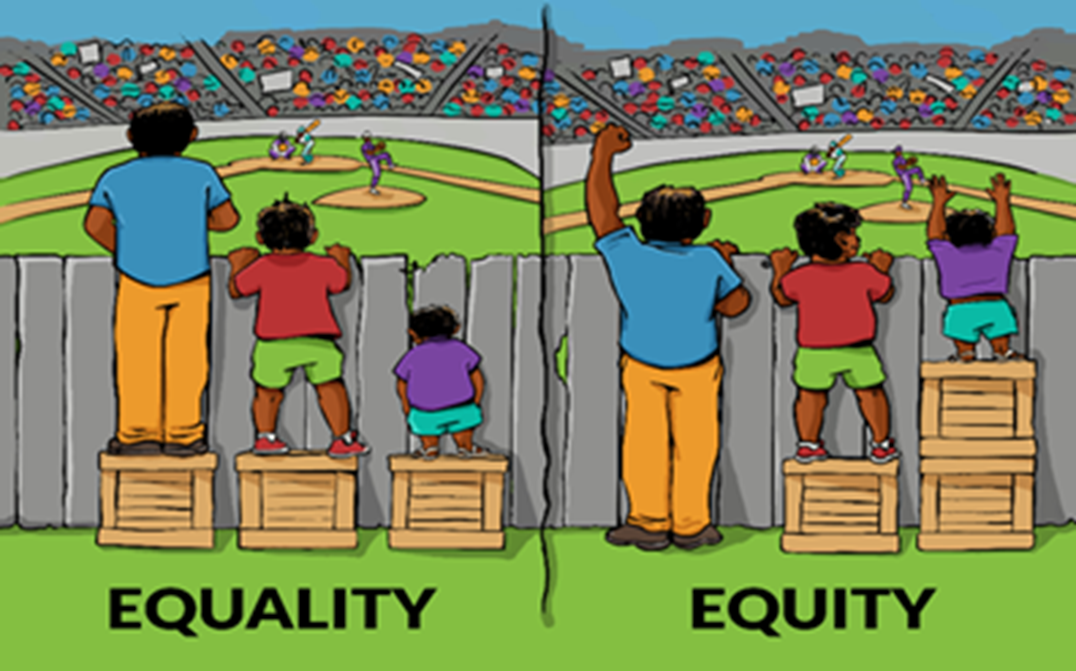
Equity vs Equality: Input vs Output

•Example: If you are disabled you need to worry about if a building is accessible.  If you are not disabled, you don’t even think about it.

•Example:  Everyone gets a pair of glasses (input, fair, equality). We want everyone to see well (output, everyone gets what they need, equity).

“Treating everyone exactly the same is not fair.  What equal treatment does is erase our differences and promote privilege.  Privilege is when we make decisions that benefit enough people, but not all people.”  Amy Sun

So think about outputs first and then work backwards to determine goals and actions to take to meet those goals.

Metrics:  Accountability = Trust

I often get asked how leadership can build trust at their companies. I think it is pretty simple, do what you say you’re going to do. When you are accountable to your promises, you build trust. So I suggest you create a very public and consistent way to show (and prove) that you are indeed working towards the goals and outputs you set for your organization.

•Create measurement and indicators so you know you’re making progress.  Create a dashboard.

•Establish a baseline with each indicator.

•Measure at multiple points, not just beginning and end.

•Regular surveys.

•Feedback loops.

•Ask the community, employees, etc.

What other ideas do you have to build trust and measure your results?

Working Effectively with the Harsh, Direct Communicator

We’ve all worked with them-the direct, sometimes even harsh, communicator.  The hairs on the back of your neck stand erect, every time you think about walking into their office to share information, ask a question or give a status update.  And although it is difficult to not take it personally, there are some specific strategies you can take to make the communication, and the relationship, an effective one.

It’s Not About You

The first thing to understand is that the direct, harsh communicator in your workplace is not directing their communication style just at you.  Direct communication is a style of communication, which   according to Myers Briggs, is one of the three styles:  Aggressive, Passive and Assertive. (http://www.au.af.mil/au/awc/awcgate/sba/comm_style.htm).  Typically, a direct communicator is all about the task at hand.  They see something that needs to get done and their incredible sense of urgency is focused on that only—not the people-side of the task, but just getting the task taken care of.  This sense of urgency is coupled with their need for speed.  In other words, they see a task, want it taken care of immediately and feel compelled to address it quickly and efficiently which means directly, and sometimes, even harshly.  So really it is not about you, the receiver, it is about getting the task off the “to do” list.

The Mindset

Another item to consider is the intercultural norms and rules in your organization.  Culture simply refers to “the way we do things around here”.  Does the culture of your workplace value the direct communication style?  Is it all about the task first and people second?  Does your workplace focus on crucial, life-dependent issues that require quick, rapid-fire communication?  Once you consider the culture and norms of your workplace, it will give you a better understanding of why the direct communicator communicates the way that they do, so don’t be offended, instead ask, “How can I help?”

The Approach

The preparation for communicating with the direct, harsh communicator is to formulate ahead of time with a single sentence headline.  For example, “We have to get an answer on the budget by Friday.” Then break down any further information into three buckets, “More specifically, there are three things I need.”  This methodology sets the stage in a direct, matter-of-fact, task-oriented style.

The direct communicator also appreciates the niceties are kept to a minimum.  Although, the initial reaction to this type of communicator, is to “kill them with kindness”, this approach will only annoy the heck out of them!  So, when e-mailing, give a greeting or nicety only once-either at the beginning or end but not both.  And when face-to-face, always ask, “Do you have a minute?”  This allows the receiver, to stop what they are doing, and truly focus on what you have to say.

It is important, that you also stay warm and lighthearted.  While definitely not easy, laugh at their insults.  Try to remember, it really is nothing about you as a person, just this person’s need to get the task completed.  Even though you are laughing at the insult, it does not mean you are a “second class citizen” so act and carry yourself as their peer—a confidante, an ally.  There is no need to grovel but don’t be sensitive either in your response communication or your nonverbal communication.  Keep it professional and the communication fact-based.

Give Feedback

If you are lucky enough to be able to give the direct, harsh communicator some feedback there are some definite tips to ensure the conversation is meaningful and helpful.  Let them know that people are afraid to talk to them.  Certainly, no one wants others to fear them but sometimes, someone just needs to know this tidbit of information so that they adjust their communication style.  Let them know that there are some very specific behaviors they could change including smiling once in a while and waiting to respond until the other person completes their thoughts.  Also, saying, “I would love to hear what you have to say first” is an effective way for the person to demonstrate that they want to listen and are open to other ideas.

Certainly an unintended consequence of direct, harsh communication is that people could be unwilling to share their ideas and comments.  This unwillingness can have drastic results for an organization that must change and grow to stay competitive in today’s marketplace.  Commit to letting the person know when they demonstrate the desired behavior or the offending behavior so that the communicator can catch themselves before repeating the undesired behavior.

Conclusion

At first glance, a harsh direct communicator may be your worst nightmare in the office, but with a little strategizing and some concrete actions, you can have effective dialogue with this type of communicator.  Put away the emotions and the automatic reflex to react or be hurt by the harsh, direct communication and understand that the communication is a result of the need for speed and task management and not an attack on you as a person.  And if you are lucky enough to be able to give feedback to this person, you might even earn some accolades in the end.
 

Winning Client Communications

Nope. Not gonna do it. I don’t think that’s a good idea. I know what I’m talking about-I’m the ID. The course will be late and I’m not sure when it’s going to be ready—I can’t commit to a date.  Would you say these things to a client? Never. How would you react if someone said these to you? Not positively.

Knowing what to say, and how to say it, to a client determines the relationship you will have with the client. And hopefully you’ll read this before the client falls in the no-longer-a-client category. Picking the right words, tone and timing in discussions with clients will enable you to develop and build a strong, supportive and mutually respectful professional relationship.

Most client communication will be handled by the Project Manager. There will be instances, however, where the ID will communicate and problem solve with the client directly. Following are examples of situations when an ID’s persuasive communication skills are important.

Declining a Client’s Request

Telling a client the change he’s making to a storyboard or the course that is not in the interest of the learner is a delicate and challenging situation. Some tips to follow:

  • Understand and be prepared to discuss consequences of the proposed changes/actions.
  • Do this only after you are certain the request is improper or not appropriate. Have a validated reason for not making the change, not just that you don’t like it.
  • Be specific. Offer examples of other instances for support of your argument.
  • Focus on the positive, such as how the experience for the user will be enhanced by your recommendation or idea.
  • Compromise with the client and never tell him “no.” There are always alternatives.

Scenario: A client provides an audio track for the course and it is too long. You fear that the length will provide the learner with a negative experience and not support the learning objectives.

 I’ve been listening to the audio provided for the course. From the learners perspective I believe it may not be the most effective option we have.
Receptive client: Why would this be a problem for the learner? [Explain]  What suggestions do you have? [Provide alternatives] Not receptive client: Well, that’s just what we’re going to use.
  ID response: In our research we have discovered …[validate your point and concern]
   

Apologizing to a Client for your Own Mistake

We all make mistakes—we’re human. Taking ownership of that mistake and correcting it is the next step.

  • Be honest and apologetic. Discuss the proposed solution as soon as possible.
  • Understand how the mistake happened anyway. Was there a breakdown in communication? Process? This will help avoid the mistake in the future and help in answering the client’s questions. Offer a realistic solution to meet the client’s needs and approval.
  • Discuss the situation immediately after the mistake is discovered. Procrastinating increases the opportunity for someone else to slip and have the client find out from someone other than you.

Scenario: You did not incorporate some particular product specifications into a course that the client was adamant about. You discover this just as the storyboard is sent to the client for review.  You decide to call the client immediately to make her aware of the situation.

I’m sorry to have to tell you this, but there is an error in the storyboard you are about to review. I did not incorporate the new product specs into the course. Frankly, I put the information in another folder and forgot to refer back to it. I apologize.
Receptive client: Thank you for your honesty. I appreciate you telling me what happened before I discovered it on my own. Now, how are you going to fix it? [Offer plan] Not receptive client: This is ridiculous. I told you several times this information had to be in the course. This mistake will throw the whole project off base now.


  ID response: I truly am sorry. It certainly was not my intent to have the project go askew like this. Please let me fix the situation immediately.

Still not receptive: Nope. This is a dire mistake. I can’t afford to have this course launch late.

ID response: Our great working relationship is important. What will it take to rebuild it?


Explaining a Delay to a Client

Our goal is to never miss a deadline. But try as we might, it does happen. Deliverable delays are costly. Not only can they be financially costly for you and the client, but they can be professionally costly. It is not an option to miss a deadline due to our own devices. This may hinder any future client business development. When you do miss a deadline, keep the following in mind:

  • Know the client may be mad or frustrated at the situation. Be prepared to remain calm.
  • Be prepared to give a summary of the problem and have a plan for completion.
  • Let the client know there is a delay as soon as possible. Let them know the new completion date, too.
  • Allow the client to vent frustration or anger. Be sure to accept total responsibility while noting any circumstances beyond your control. Offer a solution. Let the client speak last-this will help him save face and feel like he was in control of the conversation.

Scenario: Before going home one night you forget to check a storyboard to allow QA to edit the document. The storyboard is due back to you by EOD the following day so it can get to production. You are not available to check the storyboard in when QA calls you in the morning. This causes a delay of one whole day.

There is going to be a delay in getting the storyboard to production. It did not make it through our editing process in time and will not get to the graphic department until a day late. This may delay the launch of the course.
Receptive client: Well I’m sorry this happened. I trust that you will do what you can to make up lost time? Not receptive client: I only had this one day to review the SB and now that it’s pushed back a day it messes up my schedule. This is not ok and I’m not going to pay for it.


  ID response: I understand your frustration. I do apologize for the delay and will do what I can to make up the delay to you.


Conversation tips:

  • Ask questions-lots of them. Doing so demonstrates continued customer support and involvement, interactive feedback, and opportunities for the client to tell you what he wants.
  • The more you know about your client’s wants, needs, style the better the chance at providing an initial deliverable that meets his needs.
  • Prepare for calls/meetings in advance so you do not forget anything.
  • Ask open-ended question to define needs/wants/preferences of the client. This also gets the client to invest time and effort in the process, increasing his stake in the partnership and end product.
  • Don’t be afraid to ask a client for a favor, such as speeding up their review of a document. Explain how the favor will benefit you. This gives the client an idea of how much he can help you. Express gratitude.
  • When extending a deadline: realize that the client will probably be upset if you call and say you are going to miss a deadline. Give as much advance warning as possible to allow for schedule adjustments. Do not offer any excuses. Instead, explain what you are offering in return. A course requiring fewer launch issues? Better usability? Accurate translation and course delivery? Use language of negotiation and not crisis language. Examples of negotiation language include:

Aware                                     Investigate

Better                                     Caution

Careful                                   Expedite

Modify                                   Possible

Resources                             Reschedule

Answer with what you can do, not what you cannot do.

What other strategies have worked for you?

Resources:

Lifescripts: What to Say to Get What You Want in Life’s Toughest Situations, Stephen Pollan

How To Say it at Work, Jack Griffin


Getting from Ideas to Concrete Projects with Potential Clients

Being a freelancer sounds so glamorous to my full-time, gainfully employed friends.  And I agree that the flexibility and versatility is pretty sweet.  But what often gets forgotten, is that I actually have to find my work in order to have work.  So how does a freelancer truly move from concepts to actual paying work with a potential client?  There are a few things that I do that help make an initial vision turn into an actual real project.

Similar to an effective interviewing strategy when job hunting, you need to research the company that is interviewing you.  Go beyond learning the mission and the year the company was founded.  Go beyond finding out who runs the company.  Instead, figure out how this particular company ranks in the industry.  Determine the influencing factors that are shaping the industry. Learn what trends are happening that could effect the company.  So rank, influencing factors and trends are key to crafting a solution that could lead to a project.

Then determine if the particular company you want to work with is a cutting edge company or just follows standard practices. Being cutting edge or run of the mill is not right or wrong, but it does indicate how zany or normal your suggested ideas should be.  For example, if the company you are targeting likes to be a leader in their industry, do not dare suggest boring solutions that everyone else is doing, too.

Another research practice I use is to visit Glassdoor.  Often, job seekers use Glassdoor, but I contend that even as a freelancer Glassdoor can provide you with valuable insight to help aid in the solutions strategy that you must develop.  Glassdoor tells you what is working well and not-so-well at most any company you can think of.  Reading the employee comments helps you see any emerging themes and again, can guide you in your solutions.

Finally, LinkedIn is another valuable research tool.  First, see what the company is posting.  The information will give you insight on what is important to the company.  Secondly, review how you are connected to the company.  Determine if there is anyone you might know and if so, reach out to them and ask any lingering questions you might have.

So examining the industry trends, reviewing Glassdoor and researching LinkedIn are three great ways to find out more about a prospective client.  The information you glean, can help you create a solutions strategy that should be insightful, targeted and educated.  What things have you done when crafting a strategy to learn more about your client and its business?

The Beginning and the End

Similar to the joy of seeing the first spring flower or the first snowy, winter day, the beginning and end of a consulting assignment is most exciting for me. I can set the stage for success or failure by specific actions I take at both critical points in any engagement. The bookends of a project are your client’s impression bank, long after you are onto another assignment. Throughout a consulting assignment, ethics and strong communication skills are keys to a successful engagement. Unless you do what you say you are going to do and communicate along the way, the outcome will not be seen as success in your client’s eyes.

So what can you do to ensure a strong beginning and end to any of your projects?

In the beginning, the client wants to confirm to himself (or even the entire organization) that hiring you was money well-spent and that the time SMEs will spend with you (instead of doing their own job) will be a sound investment. Ultimately, will you solve the problem that you were hired to solve? By rolling up your sleeves, asking good, thought-provoking questions and listening, you can confirm to your audience that you “get it”. Don’t jump to conclusions and presume you have all the answers. Listen to the real problem to determine the root cause of the issue you are asked to solve. On the other hand, you must move fast. Unlike an employee, there is no “on-boarding” time for you; you need to put in the hours to understand the environment, culture, players and issue as quickly as possible. You were hired because you are the expert and you must demonstrate that expertise quickly in the relationship.

Assuming you met your deliverables and solved the problem (and perhaps a few additional issues) how do you end the assignment successfully? I firmly believe that you thank your stakeholder personally–either in person or with a hand-written card. I realize that in this day of email, it is easier to hurriedly spew of a few lines, but I believe it is much more meaningful to do it in person. Secondly, write up a transition plan prior to your departure, highlighting what you have accomplished, where documentation is located and any follow-up activities to ensure what you suggested or created remains active in the organization. Finally, make sure you connect on LinkedIn and even ask for a recommendation, while your success is present in the client’s mind.

What have you done to ensure a strong beginning or end to projects you have worked on?

2012 in Review

The WordPress.com stats helper monkeys prepared a 2012 annual report for this blog.

Here’s an excerpt:

The new Boeing 787 Dreamliner can carry about 250 passengers. This blog was viewed about 1,200 times in 2012. If it were a Dreamliner, it would take about 5 trips to carry that many people.

Click here to see the complete report.

Customer Service

Today’s customer service is way too transactional.  Companies expect you to scroll through a bunch of drop down boxes, narrow down your topic and then read through a frequently asked questions page to “resolve” your issue.  Is that really any way to treat a current, future or soon to be past customer?  A company’s revenue stream?  A company’s lifeblood?  I think not.  We are faced with customer service scenarios many times a day…some good impressions but most abysmal.  Yet some companies get it right every time.  How do they do that?  I think the answer is simple but first, let me share a few of my own recent examples.

 My realtor, Morgan Davis, hosts a referral party every year…15 years strong at this point.  This is a party where those that have bought, sold, referred or just because, get invited to an evening event with fun, frolic and good food.  Each year has a different theme..  This year’s theme was cowboy.  Given that Morgan is from Texas, I wonder what took him so long to come up with that theme?!  Nonetheless, he always chooses great venues, usually one that I am not familiar with.   This years was at Urban Pine.  Basically Texas dropped in the middle of eastside Portland!  On arrival, you were given a cowboy hat and vest, if you wanted.  You then caroused over to the open bar.  You were greeted by black-clad servers hauling around, nothing less than Texas toast with pimiento cheese.  The movie, The Good, Bad and Ugly was playing on two TVs, there was a photo booth (so  much fun) and a fabulous buffet.  Then a comedic skit was done and finally Morgan thanked everyone and recognized two separate people for their outstanding efforts on his behalf.  All in all a great night, that definitely solidifies that Morgan VALUES his customers.

 This party is on top of what he regularly does such as monthly perks, a referral guide and he  even stepped in when he recommended a contractor to me that failed miserably.  Morgan found another contractor and then paid for that portion of the project!!!  Wow!!

 Let’s now flip to the not so good side.  I recently upgraded my phone with Verizon.  I have been a customer for 10 years.  I spent an hour on the phone with the customer service rep.  Got my phone, loved it.  Part deux…I receive my bill and low and behold it is completely different from what she told me it would be.  When I called customer service and spent ANOTHER hour on the phone, he basically told me that the previous rep had misinformed me and he was sorry, but this is what it was.  Can we say DECEPTION!  I requested a supervisor and was told he would call me within 24 hours…can you guess it…no call yet….  Is that really how you want to treat a customer of 10 years that you are making money from each month???  Hmm, makes you wonder.

 So what can companies do to address this abysmal trend of lousy service?  Like most things, it comes from the top and needs to be pervasive in everything the company does…look at Zappos for example….the website, the policies and the interactions with the customer service reps, all scream, YOU, the CUSTOMER, are the most important thing.  But you don’t have to be big like Zappos to offer great customer service..  As a matter of fact, smile at your co-worker, offer to get something done for them and you have just provided great service.  It really is pretty simple.  But until most companies learn this, hats off to you, Morgan Davis and team and the few other companies that really get how important customer service really is.

The Shoemaker’s Wife

Trigiani tells the story of the trials and tribulations of the immigrant existence in “The Shoemaker’s Wife”.  The story begins with Eduardo and Ciro and although they are orphans living in a convent, they live the idyllic country life in their homeland of Italy.  But when the boys are kicked out of the convent, Ciro decides to claim his future by sailing to the harsh reality of New York City in the early 1900’s to learn the trade of making shoes.  Ciro woos many Italian girls in Little Italy but his mind still wanders to a girl back home named Enza.  Meanwhile Enza and her father, Marco, are forced to sail to New York, also, so that they can earn money and send it home to help make ends meet.  A chance meeting between Ciro and Enza changes everything.  Trigiani weaves a tale so believable and so immersive, I could not put this book down.  She documents the hard work and the scrupulous saving that they immigrants went through in order to realize their dreams.

What it Takes to Build a Team

Team?  What is it really?  There are thousands of articles, books, seminars and courses on team but Talent Management (August 2012) has a great article of what it really takes.  Anderson argues that “high-performance teams regularly challenge each other for their best thinking.”  How often have you seen that everyone goes with the flow or is afraid of asking a tough question?  Afterall, if you ask a tough question and your team-mate cannot answer it, you run the risk of making them look stupid or incompetent.  So how do you ask the tough questions without putting people on the defensive?

Anderson states that the first step is to change the rewards and recognition.  “To build any team, members must understand what’s in it for them and be able to tie that to their own rewards and recognition.  Once they are convinced their own needs are going to be met, most can begin to think more as “we” rather than I.'”  The next step is to work in facilitated dialogue sessions.  In these session shared goals are identified.  There also must be a thought and action shift (and lots of trust) to move to the next phase.  We are talking about a serious cultural shift in the way teams, and companies, do business.  Ultimately, “teaming in new ways, collaborating across organizational boundaries and sharing resources in new ways”  are the path to nirvana when it comes to the future of teamwork. 

Check out the article and tell me what you think!

Happy Cup

Today was the day…I became Roaster for the Day at Happy Cup Roasting.  About a month ago, I found out I had won Happy Cup’s Roaster of the Day contest.  Apparently there were 300 entries but luck was on my side.  I won coffee for a year, a day with a roaster and a once in a lifetime experience!  I was able to bring three friends with me and so I chose friends that I knew were interested in coffee and that would “blend” well together.

We learned a lot about coffee in general, the roasting process and then blended beans for a one of a kind coffee roast.  The roasting part only took about 13 minutes but apparently can very quickly go awry.  Once we roasted and cooled the beans, we bagged them and then ground some of the coffee to try our creation.  I must say it was very smooth…no milk or sugar needed!!  If you can read the bag, you will see the customized name of my roast:  “Turkish Tornado” and the “Packed by Seniye” and the date on each bag!