Second Half Rewrite

For the last six plus years I have explored what could be possible with my reset button. I’ve learned a few things. I have done a ton of research, both formal and informal, explored multiple locations and considered what is most important to me. And, of course, talked to so many people about their experiences, perspectives and ideas.

I realize that change is tough and can even be paralyzing. I can help you:

  • Figure out how to get started.
  • Consider how to keep going.
  • Learn how to pivot.
  • And everything in between.

I have created a subscription Substack. If you want help with your second half contact me and consider signing up for my Substack to get tools, tips and advice.

https://open.substack.com/pub/secondhalfrewrite/p/values

There are no incorrect choices! Please share my website and Substack with others.

Change

In the book, “Right Place, Right Time ” by Ryan Frederick, Frederick makes the statement, “Just because it’s hard doesn’t mean it isn’t the right decision.” This simple statement encapsulated exactly how I have been feeling. I love change and always have but that doesn’t mean I don’t doubt myself sometimes. Although I am making a tremendous change in my life by selling my home and wandering for the next year, I am excited and a little frightened by what I have done.

Frederick’s book focuses on finding the right home for the second half of one’s life. He asks the reader to think about Purpose, Social Connection, Physical Well Being, Financial Well Being and Place as they consider where they currently live and where they might want to live. This dashboard can aid in the decision of where to land and in what type of home (including retirement communities). Six years ago I created a weighted spreadsheet to assess similar categories. It has been a helpful tool as I have researched and visited places that might be a potential landing spot.

Some friends recently mentioned to me that I should leverage my process and what I learned to help others that are considering a late-in-life move. Perhaps a podcast or even some client coaching might be in order. I don’t feel like an expert, but I suppose I have learned a thing or two that could help others. I also might be able to coach someone that is afraid of change since change is my superpower. I look at change as an opportunity to learn, which I have always loved. For now, I am preparing for my wandering…five weeks and counting.

Inclusion: The Foundation

I am working with a new client on bolstering their inclusion practices with employees and clients. In the most basic form, inclusion is defined as “the act of including” by Merriam Webster. But we all know it is a lot more than that. In fact, all people want to feel included, valued and appreciated…or at least I know for sure that I do! So how do you create an environment where folks feel a sense of belonging, feel heard and feel safe to express their authentic selves?

First, accept that we all have bias. One of the ways to work through our bias is to talk about it. Many DEIB programs hit walls when they focused on blaming and shaming. Blaming and shaming never work, especially when you are asking someone to be open-minded to others that are different from them. Being bold enough to tackle these tough conversations is difficult since you don’t want to be called a racist, you don’t want to be misunderstood, you don’t want to offend someone and you certainly don’t relish is discomfort!

So what can you do to be more inclusive? I like this video on making assumptions and the framework is offers to Pause/Recognize/Question so that you are not misled by your assumptions (bias). Ask yourself, “What assumptions am I making?” and “How do I know these assumptions are true?”

Another tactic is to acknowledge your own preconceived ideas, move beyond generalizations and know the difference between perspective and reality. In other words:

•What messages have I received in my life that may influence my perspectives?

•What identity groups do I have the most exposure to?

•What identity groups do I have the least exposure to?

•How can I check for blind spots?

Other things you can do are expose yourself to new experiences, talk to people with different identities from your own and broaden your worldview. I love it when I talk to someone and I can say, “I never thought of that perspective or view before.” and “Wow, that’s a whole new way of looking at…” I think the American Negotiation Institute’s guiding principle says it best: “The best things in life are on the other side of difficult conversations.”

What have you done to address your blind spots?

Happy 2025!

Almost everyone I know loves New Years Eve. Who couldn’t love the opportunity to hit the reset button?! And after some years, the reset button is a welcome reprieve. I suggest pausing for a moment, though, to consider the following:

  • What worked in the previous year that you should consider repeating?
  • What definitely didn’t work and so stopping immediately is wise?
  • What could be tweaked to get even better results?
  • What was too easy and therefore doing you no good?
  • What do you want to get better at, even if it is scary?
  • What did you learn? Both positive and negative.
  • How do you want to take care of yourself and others?

I am sure there are a million other questions I didn’t even think of, so what are your additions? Let me know.

What’s Your Defining Moment of 2023?

It’s difficult to believe that 2023 is coming to a close. I feel, like many I am sure, that I was just celebrating New Years Eve yesterday! 2023 has been a pretty good year, especially compared to last several years of craziness! I had six new clients this year and two ongoing clients. I created a DEI practitioners group, delivered three industry presentations and provided yearlong mentoring to several women. I also took on volunteering weekly teaching English to local refugees and immigrant newcomers. Teaching ESL has been more challenging than I originally envisioned but it’s certainly rewarding work to see someone so motivated to improve their circumstances through learning English.

As we end this year, I think its important to pause and think about what 2023 meant to us personally and what we hope for 2024. The beginning of a new year allows us to start fresh, which can be invigorating. I write down my goals for 2024 (both work and personal) and also a bucket list for the year, too. Writing things down for me makes the goals and desires tangible. And who doesn’t love crossing something off a list??!! I also go through my calendar week-by-week to see all I really accomplished. And since I use IG as an online journal, I revisit all my posts to relive the year in pictures!

So goodbye 2023 and HELLO 2024. I wish everyone a healthy and happy 2024.  What will be your defining moment for 2024? Plan now and make it happen!

Share in the comments what you do to close out one year and welcome the next.

“Atomic Habits” by James Clear

“Imagine changing just one word: You don’t ‘have’ to. You ‘get’ to.”

James Clear, page 131

I just finished reading “Atomic Habits” and even though I consider myself a highly disciplined and motivated person, this book still gave me some great ideas. I appreciated all the examples and resources available on Clear’s website. I will be the first person to admit that most business books can (and should be) encapsulated in a two-page article but Clear’s book is the exception. I loved Clear’s quote, “Habits are the compound interest of self-improvement.”

I certainly believe this is true for myself. For example, I work out every day. Come rain or shine, I am committed to MOVE every day. I walk, hike, play tennis and lift weights every week. I have been doing this since I was a teenager. I also was a big runner but my knee is troublesome now. Having knee pain and being unable to run (which I loved to hate) could have led me to be sedentary, but instead I was committed to keep moving in new and different ways. This commitment to the habit of moving has served me and my body well in middle-age. So Clear’s premise that habits can compound for or against you is definitely true in my case.

I also like Clear’s belief that habits are not about goals but instead about systems. Creating systems that support your habits makes complete sense. For example, when I traveled a lot for work, it would be easy to leave the airport and go home right away but I noticed that meant I was working out less. So I came up with a plan to have my workout clothes in the trunk of my car, this way I could easily drive directly to the gym from the airport instead of depending on myself being disciplined enough to go home to change and then drive to the gym.

Another recent example is taking my vitamins. I need to take some daily vitamins and yet I could never remember to do it. I also hate clutter on my kitchen counters but I knew in order to take my vitamins, they needed to be in easier reach (and sight). So the vitamins sit on my kitchen counter and are impossible to miss each morning. I am happy to say, I now take my vitamins daily because I designed my environment for success!

I am a big believer of taking ACTION. Clear shares a great story about taking action. In summary, a photography class broke the students into two groups: quantity and quality. In the quantity group, the students were graded by number of photos taken. It did not matter if they were good photos. The goal was to take a lot of photos. The quality group was required to turn in one photo for the entire semester. Their grade would depend on excellence. At the end of the term, all the best photos were taken by the quantity group. This group experimented, tried new methods and ideas and most importantly, learned from their mistakes. While taking hundreds of pictures, they improved their skills. Ultimately is it easy to get focused on perfection or ideas whereas taking action actually delivers an outcome. Talking or thinking about something does not produce results only ACTION produces results.

I loved the concepts of this book. If you read it or have read it already, share what you learned in the comments section!
“The Wake Up” Part Two

Reading “The Wake Up” by Michelle Mijung Kim has been powerful and informative. She shares so much great information. Her comment, “Many of us desire to have good impacts, but sometimes even our best intentions can bring unintended consequences of harm.” This results in fear to do or say anything but then harm is also caused by inaction.

Kim suggests a few things to do when you get called out for being harmful:

  • Listen and calm your defenses.
  • Apologize and acknowledge the harm.
  • Express gratitude for the feedback.
  • Make amends without expecting forgiveness.
  • Commit to doing better and then actually do better.
  • Get support for yourself.

This Year is Flying By!

Fall is here, hence the pumpkin-flavored everything all around us! So as the year is coming to a close with only three full months left, now is a great time to look backward and forward.

Some things to consider:

  • What do you still want to accomplish before year end?
  • What is reasonable to accomplish by year end?
  • What would be most valuable to accomplish by year end?
  • What have I already accomplished that will set me up for success in the new year?
  • What should I repeat next year?
  • What do I still need to accomplish, learn or get rid of?

What other things should you consider to close out this year and begin the next year?

“Say the Right Thing”

I love learning new things and certainly have spent the last several years reading, watching and listening to anything I can get my hands on about diversity, equity, inclusion, bias and belonging. So I recently picked up, “Say the Right Thing” by Kenji Yoshino and David Glasgow. The premise of the book is to learn how to talk about identity, diversity and justice.

The authors suggest a framework called A.D.D.A. which stands for avoid, deflect, deny and attack. The authors contend these are conversational traps that one needs to be aware of and prepare for as one tries to have conversations around identity, diversity and justice issues. I thought this framework really did capture how conversations derail, sometimes before they even start!

One line in the book really captured the issue for me:

As excruciating as it can feel to have conversation about identity, it’s important to remember people from nondominant groups have always experienced emotional turmoil in these dialogues from being ignored, mocked, tone policed, or subjected to retaliation. When you find yourself wondering, “Why am I so uncomfortable? You might instead ask, “Why have I been comfortable until now?” You might then hear the answer: “I’ve been comfortable because until today, the other person has carried all the discomfort on their own.”

The authors suggest some strategies to deal with the emotional discomfort of these types of conversations such as a growth mindset by treating mistakes as opportunities to learn, self-affirm by reminding yourself what is most important and right-size feedback by remembering claims about privilege are often not as extreme as you perceive them. Reframing the situation can make you more open to the conversation in an objective way.

There are lots of helpful nuggets in this book. The authors share stories, examples and suggestions. One of the ending notes I think was helpful, “Don’t ignore people’s group identity, but also don’t reduce them to their group identity.” And finally, educate yourself! It is your responsibility to do so. Be curious, humble and ask for help but don’t expect someone else to educate you. Check out this book and let me know what you learned.

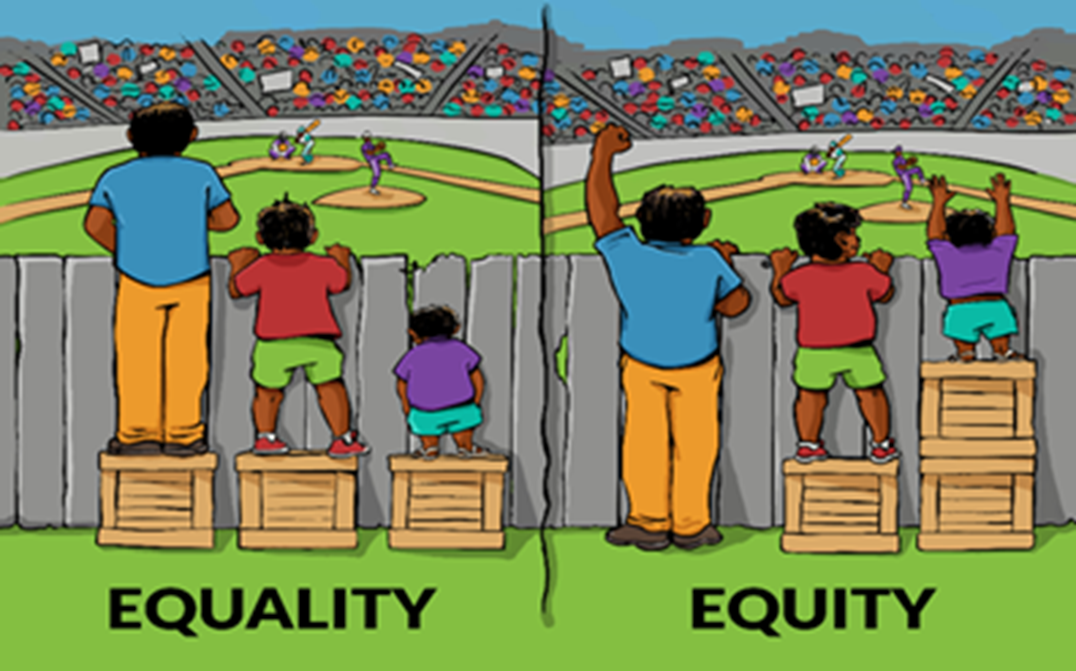
Equity vs Equality: Input vs Output

•Example: If you are disabled you need to worry about if a building is accessible.  If you are not disabled, you don’t even think about it.

•Example:  Everyone gets a pair of glasses (input, fair, equality). We want everyone to see well (output, everyone gets what they need, equity).

“Treating everyone exactly the same is not fair.  What equal treatment does is erase our differences and promote privilege.  Privilege is when we make decisions that benefit enough people, but not all people.”  Amy Sun

So think about outputs first and then work backwards to determine goals and actions to take to meet those goals.

Metrics:  Accountability = Trust

I often get asked how leadership can build trust at their companies. I think it is pretty simple, do what you say you’re going to do. When you are accountable to your promises, you build trust. So I suggest you create a very public and consistent way to show (and prove) that you are indeed working towards the goals and outputs you set for your organization.

•Create measurement and indicators so you know you’re making progress.  Create a dashboard.

•Establish a baseline with each indicator.

•Measure at multiple points, not just beginning and end.

•Regular surveys.

•Feedback loops.

•Ask the community, employees, etc.

What other ideas do you have to build trust and measure your results?