
Subscribe to continue reading
Subscribe to get access to the rest of this post and other subscriber-only content.
Subscribe to get access to the rest of this post and other subscriber-only content.
Training is a necessary component to any change initiative. And the topic of DEIB makes training that much more crucial. I believe training in this space is about creating “ah ha” moments rather than telling people what they have done wrong. Think about it…who wants to be reminded of all their faults and poor behavior. Ultimately we need people to WANT to learn and to change and to grow and to EVOLVE.
Some key points for your training to be successful are:
•Employees need to learn about each other, connect and engage.
•Focus training on positive actions employees can take.
• Discuss how can employees positively affect an outcome.
•Workplace training on rules, regulation and what behaviors are prohibited should be a separate session.
•Think about pre and post-work. Level-set definitions and base information so that the classroom gets used for the important stuff like dialogue and discussion!
•Importance vs. time devoted. Too often I hear companies saying, “We can only devote one or two hours to this session.” Well, if DEIB is as important as you say it is, doesn’t it deserve an appropriate amount of time to train??!!
Multiple sessions vs one long one. This helps work around the belief that there isn’t enough time. It also allows people to ruminate and consider what they learn, put it into action and then return for the next training session.
There is lots of discussion on whether or not training should be voluntary. Some points I think you should consider are:
•Employees should believe they are opting in.
•Deliver a clear and consistent communication plan that shares importance, expected outcomes and opportunity to be involved.
•Remind employees it is not voluntary to be inclusive at work.
•Consider what your competition doing? And then ask, “Does it matter?”
•Training is centered around white people. Ask your what marginalized employees need. This is overlooked almost 100% of the time but is a very valuable perspective.
Let me know what other strategies have worked for DEIB training.
•Example: If you are disabled you need to worry about if a building is accessible. If you are not disabled, you don’t even think about it.
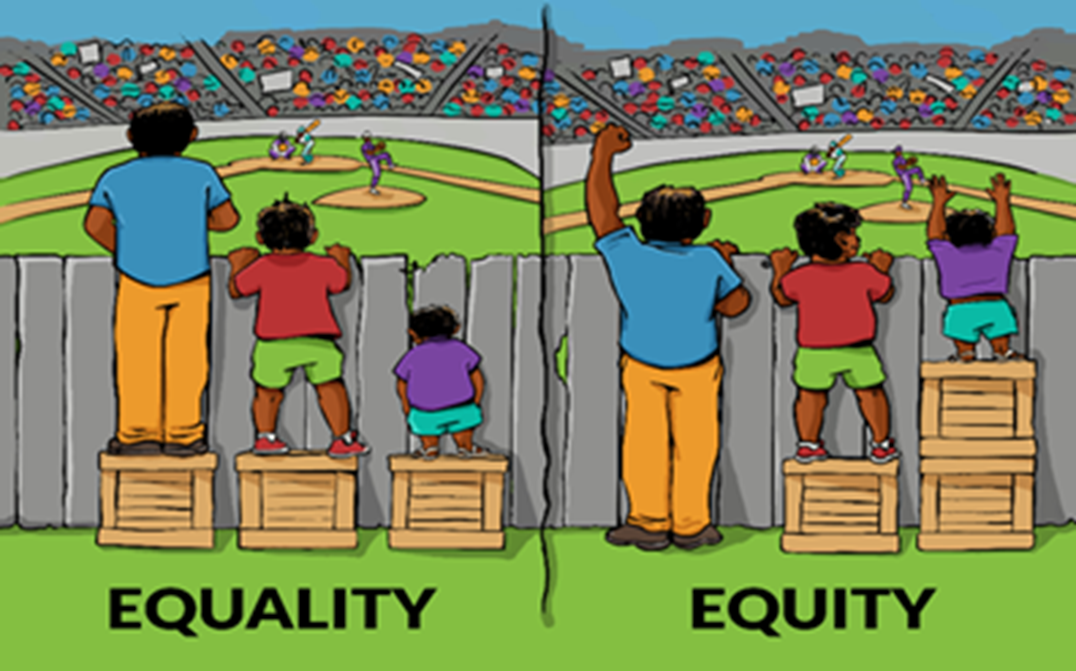
•Example: Everyone gets a pair of glasses (input, fair, equality). We want everyone to see well (output, everyone gets what they need, equity).
“Treating everyone exactly the same is not fair. What equal treatment does is erase our differences and promote privilege. Privilege is when we make decisions that benefit enough people, but not all people.” Amy Sun
So think about outputs first and then work backwards to determine goals and actions to take to meet those goals.
Metrics: Accountability = Trust
I often get asked how leadership can build trust at their companies. I think it is pretty simple, do what you say you’re going to do. When you are accountable to your promises, you build trust. So I suggest you create a very public and consistent way to show (and prove) that you are indeed working towards the goals and outputs you set for your organization.
•Create measurement and indicators so you know you’re making progress. Create a dashboard.
•Establish a baseline with each indicator.
•Measure at multiple points, not just beginning and end.
•Regular surveys.
•Feedback loops.
•Ask the community, employees, etc.
What other ideas do you have to build trust and measure your results?
I recently spoke at an HR & Benefits conference on how to begin and/or refine your DEIB efforts in order to actually be successful in moving the needle in this important work. I will share some of my ideas over several posts. Contact me if you want to know more!

First let’s lay the foundation of some definitions. I adapted this Bank of America graphic and added the Belonging information. So if you start with these definitions and develop outcome goals from there, you will focus on the right outcomes and the right problems so that you design the right solutions. When developing your strategy, know your starting point and what you want the future state to look like and achieve.
A few other things to think about as you develop a strategy:
•Know the power dynamics at your organization.
•Know what you will measure and how. How do we know we have met our outcome goals?
•Establish a baseline-employee satisfaction, engagement, retention, turnover, demographics, surveys.
•Identify resources: Internal/ external.
•Budget: You need one!
•Define terms so that everyone understands.
•Create a playbook.
•Don’t try to take on too much.
I’ll stop there. My next post will continue the conversation on developing a DEIB focus at your organization. Leave a comment if you have any other ideas when developing a strategy.
Next week, I am co-presenting a session to a group of women new in their careers. Our topic is how obstacles can hinder women’s careers in the workplace. We all know bias exists and it certainly is a challenge for women…all women. I have witnessed it. I have experienced it. And I don’t want my daughters (or any other woman) to have to deal with it.
I have created some pre-work to set the stage for the face-to-face training, which I have shared below.
Individual Reflection:
1. What is my first memory of seeing or experiencing someone different from me?
2. When was there a time in my life that I felt different from others?
3. How did you deal with the situations above?
Read This:
Bias Holds Women Back (forbes.com)
Individual Reflection:
1. What was your reaction to this article?
2. Have you ever experienced or witnessed any of the bias the article discusses?
3. How did you deal with the situations above?
During the live session, we will walk through what bias looks like, how we all have bias and some things we can do when we see or experience bias. I know that women new in their careers might not be willing to speak up, but my hope is to share some tools that will help them address bias in a thoughtful, intentional, empowering way.
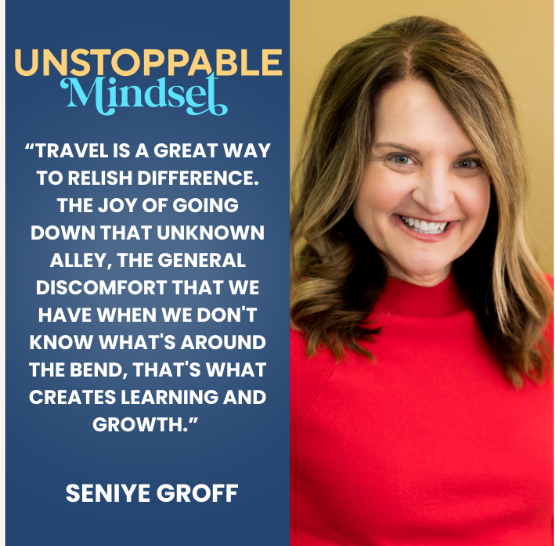
I had such a great time being interviewed by Michael Hingson from Unstoppable Mindset. We spoke about a variety of topics. Driving the conversation and taking a proactive role is the crux of my conversation. Michael has such an interesting story and perspective, himself. Listen on and contact me with questions, comments and feedback!
“It’s easy to stand with a crowd. It takes courage to stand alone.” Mahatma Gandi
Besides my consulting work, I have signed on for two speaking engagements in April. One session is focused on early career women and how to overcome barriers in their careers. The second presentation is an HR/Benefits one day conference. I will be presenting on how to jumpstart DEI efforts at organizations. This audience is mainly HR and CFO folks.
I love presenting, sharing ideas and hearing stories from audiences. For the barriers presentation, this article provides a nice overview and some much-needed pre-work for audience self-reflection. I think back to my career and how I put up with so much “wrong” stuff early in my career due to fear, lack of knowledge on what to do and just overall naivete. Even in present day, the barriers are pretty much the same…women hold little power and are subject to so much bias. And then couple that with being a women within another marginalized group and imagine the obstacles, doubled or tripled!
I remember being told that you must “ask for what you want” yet even as recent as five years ago, when I did that, I was told, “Leadership will decide when you are ready…not you.” Unbelievable and yet, as women, we are forced to comply or start over. In this example, it was the beginning of me realizing exactly the environment I was working in and fortunately, I had options so didn’t need to stay.
But most women don’t have options or fear sticking their neck out and saying something. How do we teach women to move beyond this fear? First, we talk openly about it! If we normalize behavior that holds women back is acceptable, it will continue. I think we also need to make women aware of bias and what it looks like and actions they can take against it.
Bias “is a human trait resulting from our tendency and need to classify individuals into categories as we strive to quickly process information and make sense of the world.” There are two types of bias:
Explicit cognitive bias includes overt racism and racist comments; “individuals are aware of their prejudices and attitudes toward certain groups.”
Implicit cognitive bias “involves all of the subconscious feelings, perceptions, attitudes, and stereotypes that have developed as a result of prior influences and imprints.” Implicit cognitive bias “involves all of the subconscious feelings, perceptions, attitudes, and stereotypes that have developed as a result of prior influences and imprints.” Implicit cognitive bias involves “automatic, unconscious mental processes based on implicit attitudes or implicit stereotypes that are formed by one’s life experience and lurk behind the surface of the conscious.” Implicit biases are necessary for us to survive since our brains cannot possibly process every piece of information coming at it in real time for us to make decisions. Our brains learn to categorize similar things so we can react. EVERYONE has Implicit Bias. A preference for a group (positive or negative) often operating outside our awareness and based on stereotypes and attitudes we hold that tend to develop early in life and tend to strengthen over time.
“Courage is resistance to fear, mastery of fear—not absence of fear.” Mark Twain
Individual Reflection:
1. What is my first memory of seeing or experiencing someone different from me?
2. When was there a time in my life that I felt different from others?
3. How did you deal with the situations above?
Bias
Conscious Bias
Unconscious Bias
Bias in Action
Bias effects
Q: When have you experienced or witnessed bias? What happened? What was done about it? What was the end result?
Who are you?
Or
Q: Which one are you? Provide an example.
Sources of your bias:
All of these create your identity. Your identity can be sources of positive and negative bias. Some of our identifiers cause us to be biased to others and others to be biased towards us.
Q: What is your identity? Note if any create bias towards others.
How to Disrupt Bias (within yourself)
Q: Think about who you connect with, hang out with, spend time with, ask advice from…do they look different or similar to you? Why?
Broaden your viewpoint by:
Take Action
Ways to Act with Courage
Q: What are specific ways you can act with courage as described above?
Your perspectives are incomplete. You are an expert on your identity…be willing to learn about others.
Types of Bias
Take action: What could we do differently?
Take action: What could we do differently?
Take action: What could we do differently?
Take action: What could we do differently?
Take action: What could we do differently?
Take action: What could we do differently?
“Courage is an inner resolution to go forward despite obstacles; cowardice is submissive surrender to circumstances.” Martin Luther King
Share your experiences and ideas…and what you can do differently.

…Action is where real change happens. Change can feel thorny but nothing changes without action.
So today is International Women’s Day. First of all, I hate innocuous holidays or celebrations because what purpose do they really serve except for a feel-good?
I say it over and over…
“Talk is cheap. Action is where real change happens!”
It feels good to share platitudes, recognition and high-fives. But my question is, “What are you going to do about it?” Action must happen to make change happen. All the greatest intentions accomplish little. Instead, think about actions you can take to change the system such as:
Share your ideas in the comments. Together we are stronger.
#change #takeaction
I recently finished reading “How to Have Difficult Conversations About Race” by Kwame Christian. I believe stumbling blocks do exist about how to get the conversation started and folks avoid the tough discussions all together. Conversations about race are loaded with minefields of discomfort, misunderstanding and lack of know-how. But does that mean we avoid these discussions all together?! Absolutely not because if we avoid, we never solve.
I loved Kwame’s suggestion to mobilize compassionate curiosity. For one thing, what a great way to remove defensiveness by calling it curiosity. His framework includes three steps:
Compassionate curiosity can (and should) not only be used with others, but also yourself. I have spoken before about being on auto-pilot and a great way to move away from this mindless way of acting is to stop and question yourself (and others) on why they believe something…in other words step back to self-reflect. Other phrases such as, “Tell me more about…and help me understand” are powerful, empathetic ways to learn where someone is coming from. Kwame’s book walks through this methodology in great detail and with examples, which are very helpful to guide the reader into action (and comfort).
Another eye opener in his book discusses speaking the same language. Kwame states, “The dictionary definition of a word isn’t important. What’s important is what the person you’re talking to believes the word to mean.” Great examples are the words privilege and inclusion. I loved his explanation of how conversations get derailed when agreement on what the word even means is not established yet! I am definitely adding this important step to my conversations. Check out chapter six to learn more and get detailed examples.
It is not new information to not speak in absolutes and Kwame touches on this, too. He suggests to use often instead of the word always. Also, use likely or frequently instead of will and finally use rarely or infrequently instead of never. Just say those words aloud and you can already sense how the conversation can change for the better.
In my mind taking action is front and center and Kwame focuses the last section of his book on this important verb. He states, “racial inequity is a problem of bad policy not bad people.” So he is a proponent of changing inequitable policies that create inequitable outcomes rather than individual beliefs. “Progress doesn’t move at the speed of comfort.” Wow and YES! If we wait for people to be comfortable we will never move…we will wait forever. And my biggest pet peeve, hope vs. action. For example, our hope and prayers are with families every time there is a mass shooting but until we actually take ACTION and change policy, nothing will truly change. Kwame suggests that with policy change hearts and minds actually do change. An example is how organizations had to quickly pivot due to COVID-19, whereas in typical times that severe change would have taken likely decades!
Another powerful sentiment of Kwame’s that I definitely know about (and likely anyone in the DEI space has experienced) is this:
“When you’re advocating for change within your organization, you may be seen as an irritant, too. Difficult conversations can make people uncomfortable and that discomfort can lead people to blame the irritant, because it seemed as though everything was fine before someone spoke up. People often struggle to see a problem if it’s not a problem for them. But the irritant of advocacy is the medication necessary to cure the greater ill of racism.”

I read recently that DEI professionals have an average of an 18 month lifespan (just a little shorter than Greek ruins). I don’t find this surprising given the many stories DEI peers have shared about being in a DEI-focused role in an environment resistant to change…a system resistant to change…a country and even a world resistant to change. Over and over I hear about DEI professionals with targets on their backs for just trying to do their jobs. Why is that? WTF is more like it! I am pretty confident that DEI professionals are not in their jobs to be a “check the box” role in their organizations. DEI work is emotional work. It is hard work and I know we do this work so that we can MAKE a difference, not just serve in a figurehead capacity.
So how do we determine if our role is just fluff filled with lip service? I have a few suggestions of things to dig deeper on to determine if it is time to move to an organization that actually means what they say. To be fair, the type of change we are all working towards is not fast work. The needle will move slowly but it still needs to move and I want evidence that it is actually moving.
Budget. No project, initiative or role can move forward without money. Having a budget (and being able to use that budget) signals that there is validation for your efforts. A budget allows you to tie strategic goals with money to accomplish those goals.
Positions. You might momentarily feel proud of yourself that the organization finally “put their money where their mouth is” and created a full-time, singularly-focused DEI role. You might say to yourself, “finally the organization realizes this role is critical.” But I say not so fast because you will find that there actually is way too much work for one person. One subtle way to stop progress is to bury the DEI professional with so much work that they cannot see the what’s really going on. So, don’t gloat so quickly and instead determine what roles are needed to really do the WORK and then make the case to get those roles hired.
Authority. Do you have a seat at the proverbial table? If not, you will get mired in layers of approvals and suddenly the simplest thing like a educational article or training event will get stuck in roadblocks and potholes. You basically sit at the red light eternally…or until the article or topic’s essence is no longer current with whatever the issue was that you wanted to highlight.
Diversions. Leadership will throw you a bone and tell you how great you are doing…what an awesome influence you are making on the organization. Don’t be fooled…incremental changes like getting the organization to stop using some male-focused words in not what we are after. Yes, it is great to change the bias vernacular that your organization is using but it will never be more impactful than true, systemic changes like digging deep into your recruiting practices and eliminating bias from the process. For example, where does the organization choose to recruit from to how they interview all the way to how they decide if someone is a “fit”. If we continue to hire folks like what we already have then we continue to live in our bubble of sameness.
Employee Resource Groups (ERGs). Creating an environment where ERGs are not only allowed to form, but actually encouraged, will empower employees with shared identities, characteristics, and/or life experiences to come together to collaborate and support each other. It also will enable other employees to learn how to be come allies, a necessary ingredient for change to happen.
We are overdue to band together as a profession and as human beings. As Brene Brown mentioned in her latest book, Atlas of the Heart, “I’m here to get it right, not to be right.” Let’s get it right by setting ourselves up to successfully do the work and make an impact in this world for generations to come. Frankly the world is evolving and change is a part of evolution.
What does getting it right look like? Please comment and let’s figure out how we can support each other and the systemic change so overdue.
 seniyegroff