DEIB Training Efforts

Training is a necessary component to any change initiative. And the topic of DEIB makes training that much more crucial. I believe training in this space is about creating “ah ha” moments rather than telling people what they have done wrong. Think about it…who wants to be reminded of all their faults and poor behavior. Ultimately we need people to WANT to learn and to change and to grow and to EVOLVE.

Some key points for your training to be successful are:

•Employees need to learn about each other, connect and engage.

•Focus training on positive actions employees can take. 

• Discuss how can employees positively affect an outcome.

•Workplace training on rules, regulation and what behaviors are prohibited should be a separate session.

•Think about pre and post-work.  Level-set definitions and base information so that the classroom gets used for the important stuff like dialogue and discussion!

Importance vs. time devoted. Too often I hear companies saying, “We can only devote one or two hours to this session.” Well, if DEIB is as important as you say it is, doesn’t it deserve an appropriate amount of time to train??!!

Multiple sessions vs one long one. This helps work around the belief that there isn’t enough time. It also allows people to ruminate and consider what they learn, put it into action and then return for the next training session.

There is lots of discussion on whether or not training should be voluntary. Some points I think you should consider are:

•Employees should believe they are opting in.

•Deliver a clear and consistent communication plan that shares importance, expected outcomes and opportunity to be involved.

•Remind employees it is not voluntary to be inclusive at work.

•Consider what your competition doing?  And then ask, “Does it matter?”

•Training is centered around white people.  Ask your what marginalized employees need. This is overlooked almost 100% of the time but is a very valuable perspective.

Let me know what other strategies have worked for DEIB training.
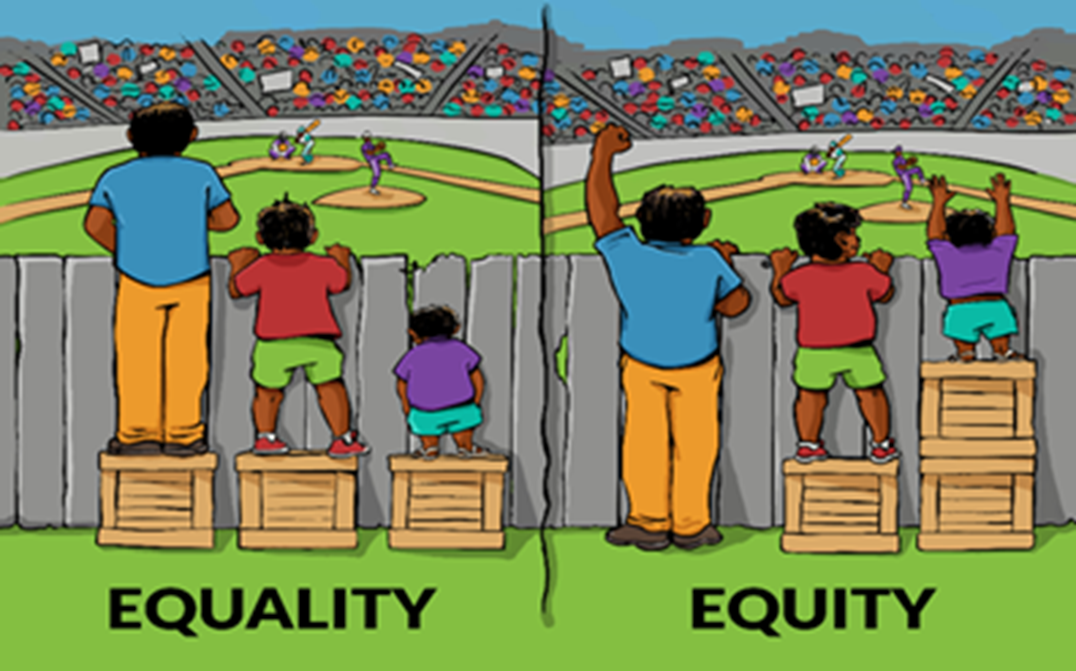
Equity vs Equality: Input vs Output

•Example: If you are disabled you need to worry about if a building is accessible.  If you are not disabled, you don’t even think about it.

•Example:  Everyone gets a pair of glasses (input, fair, equality). We want everyone to see well (output, everyone gets what they need, equity).

“Treating everyone exactly the same is not fair.  What equal treatment does is erase our differences and promote privilege.  Privilege is when we make decisions that benefit enough people, but not all people.”  Amy Sun

So think about outputs first and then work backwards to determine goals and actions to take to meet those goals.

Metrics:  Accountability = Trust

I often get asked how leadership can build trust at their companies. I think it is pretty simple, do what you say you’re going to do. When you are accountable to your promises, you build trust. So I suggest you create a very public and consistent way to show (and prove) that you are indeed working towards the goals and outputs you set for your organization.

•Create measurement and indicators so you know you’re making progress.  Create a dashboard.

•Establish a baseline with each indicator.

•Measure at multiple points, not just beginning and end.

•Regular surveys.

•Feedback loops.

•Ask the community, employees, etc.

What other ideas do you have to build trust and measure your results?

Jumpstart Your DEIB Efforts

I recently spoke at an HR & Benefits conference on how to begin and/or refine your DEIB efforts in order to actually be successful in moving the needle in this important work. I will share some of my ideas over several posts. Contact me if you want to know more!

First let’s lay the foundation of some definitions. I adapted this Bank of America graphic and added the Belonging information. So if you start with these definitions and develop outcome goals from there, you will focus on the right outcomes and the right problems so that you design the right solutions. When developing your strategy, know your starting point and what you want the future state to look like and achieve.

A few other things to think about as you develop a strategy:

•Know the power dynamics at your organization.

•Know what you will measure and how.  How do we know we have met our outcome goals?

•Establish a baseline-employee satisfaction, engagement, retention, turnover, demographics, surveys.

•Identify resources: Internal/ external.

•Budget: You need one!

•Define terms so that everyone understands.

•Create a playbook.

•Don’t try to take on too much.

I’ll stop there. My next post will continue the conversation on developing a DEIB focus at your organization. Leave a comment if you have any other ideas when developing a strategy.